Appendix 3
Asset pricing under existential risk: a literature review
1. SAVINGS AND “EXISTENTIAL” / DISASTER RISKS
Russett and Slemrod (1993)
-
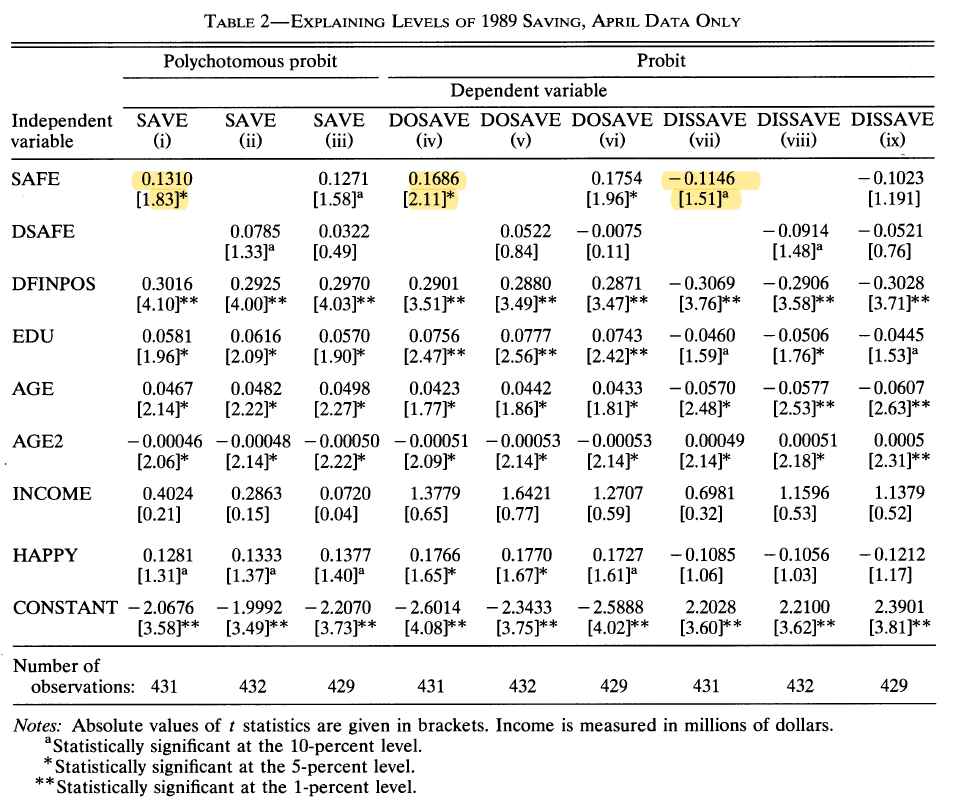
1990 survey data
-
Survey people about their savings behavior and their beliefs about nuclear war risk
-
Savings behavior: “Considering all your savings and reserve funds, during 1989 did you put more money into your savings and reserve funds than you took out, or did you take out more money than you put in?”
-
Nuclear war risk: “How likely do you think it is that we will get into a nuclear war within the next ten years? Do you think it is very likely, somewhat likely, somewhat unlikely, or very unlikely?”
-
Find a negative relation (i.e. higher risk is associated with lower savings)
-
Table:
-
Save: for negative/zero/positive net saving
-
Dosave: if save == 1
-
Dissave: if save == -1
-
Safe: index of subjective probability of nuclear war
-
Very likely: 1
-
Somewhat likely: 2
-
Somewhat unlikely: 3
-
Very unlikely: 4
-
“D” prefix indicates change in variable
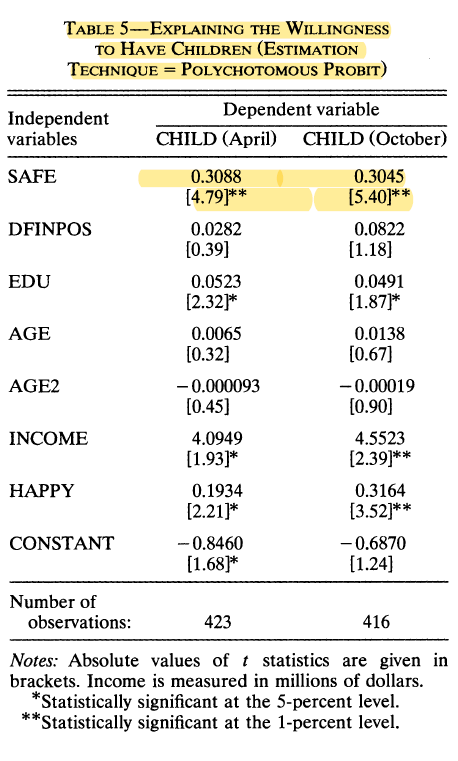
- Also associated with willingness to have children
Russett, Cowden, Kinsella, and Murray (1994)
-
Look at timeseries association between (1) savings and (2) survey of US expectations for nuclear war
-
Multiple survey sources from 1946-1965, 1976-1993; stitching/imputing/interpolating[!!] different questions together as best as possible
-
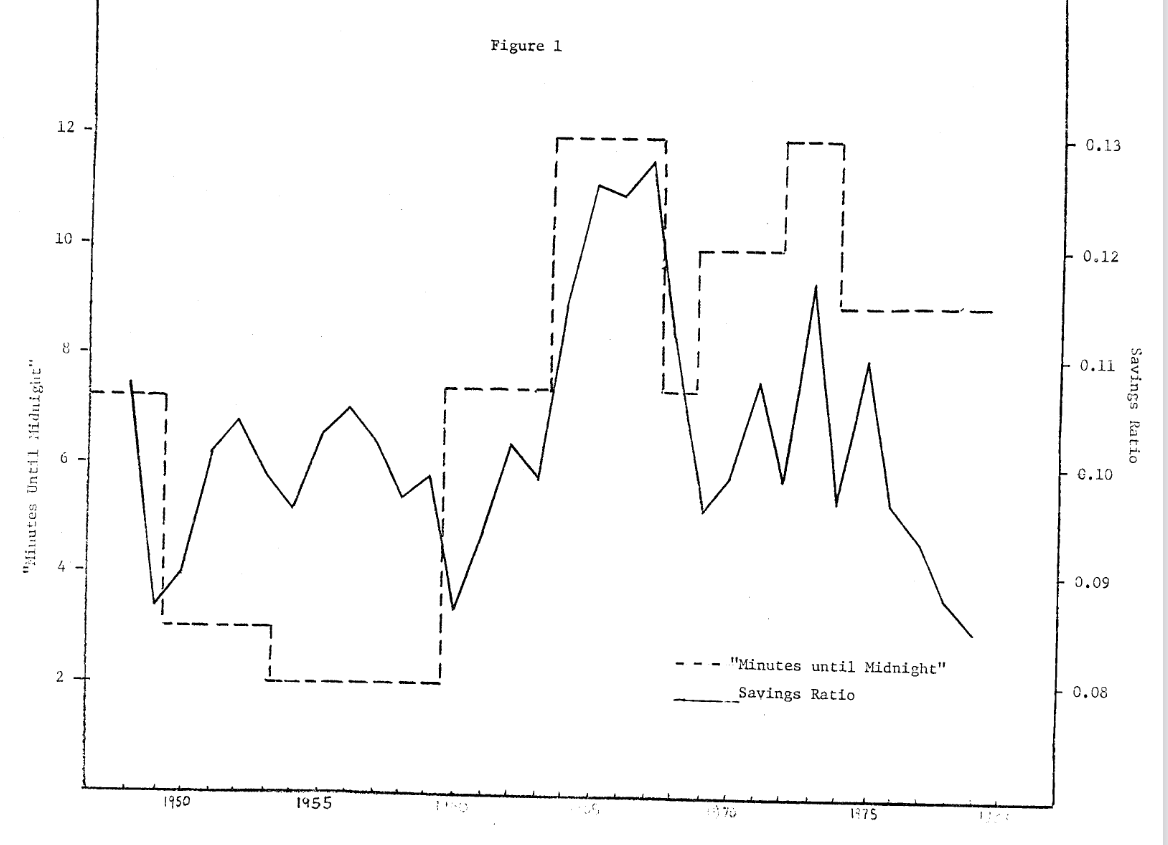
Look at timeseries association between (1) savings and (2) Bulletin of Atomic Scientists index of international tensions/doomsday clock
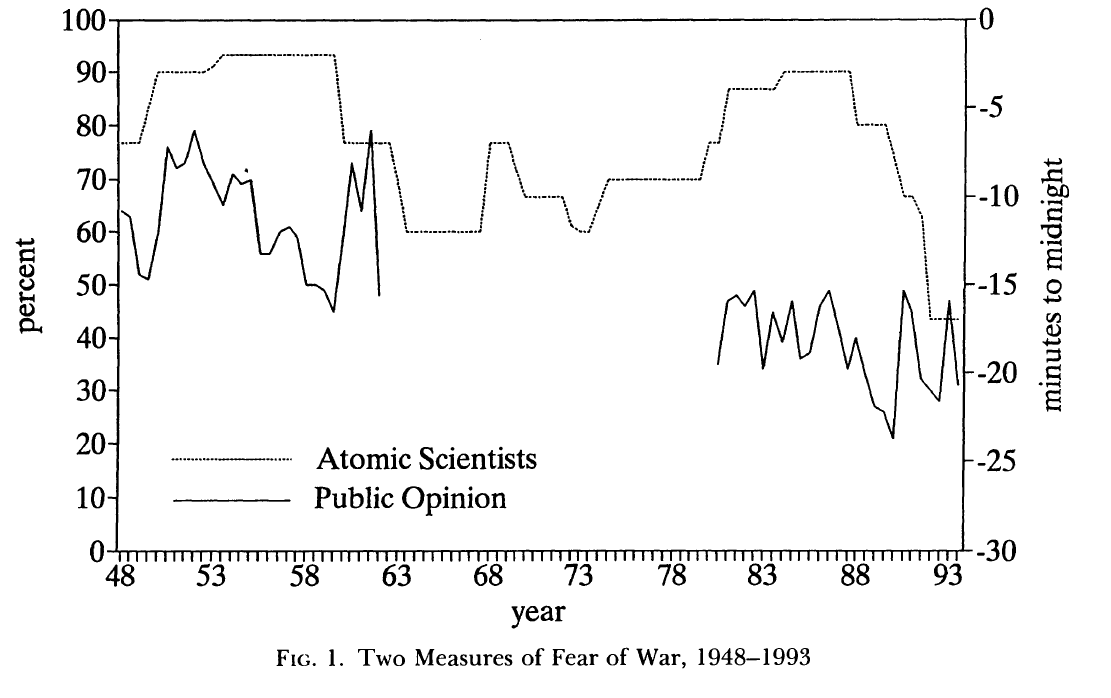
- Looks a bit like noise tbh
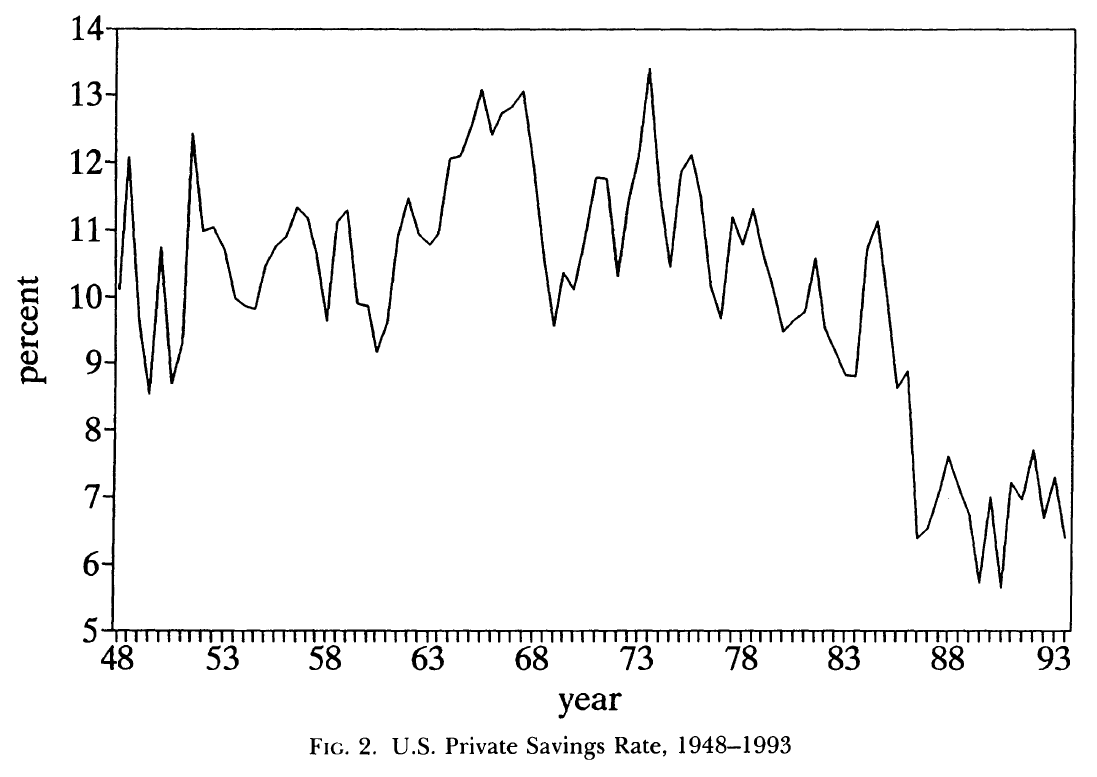
- Regression:
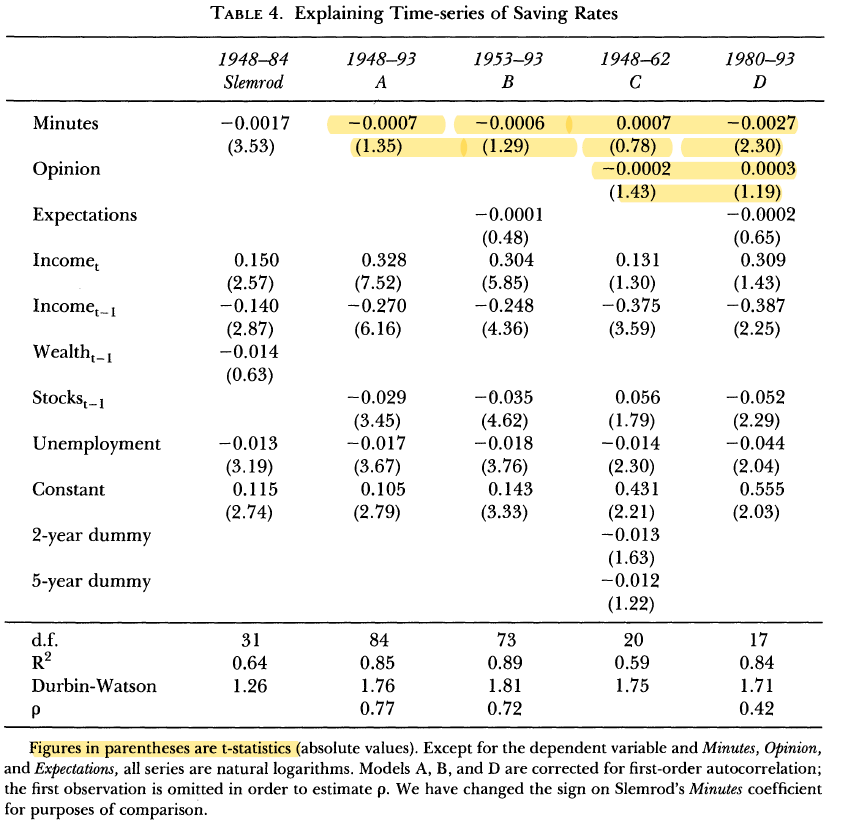
- Why tf do they put both measures in the same regression…?
Related papers:
-
Slemrod (1986) does the same, but with just the BAS
-
Russett and Lackey (1987) use some European data
Slemrod (1982)
Lol:
Slemrod (1990)
-
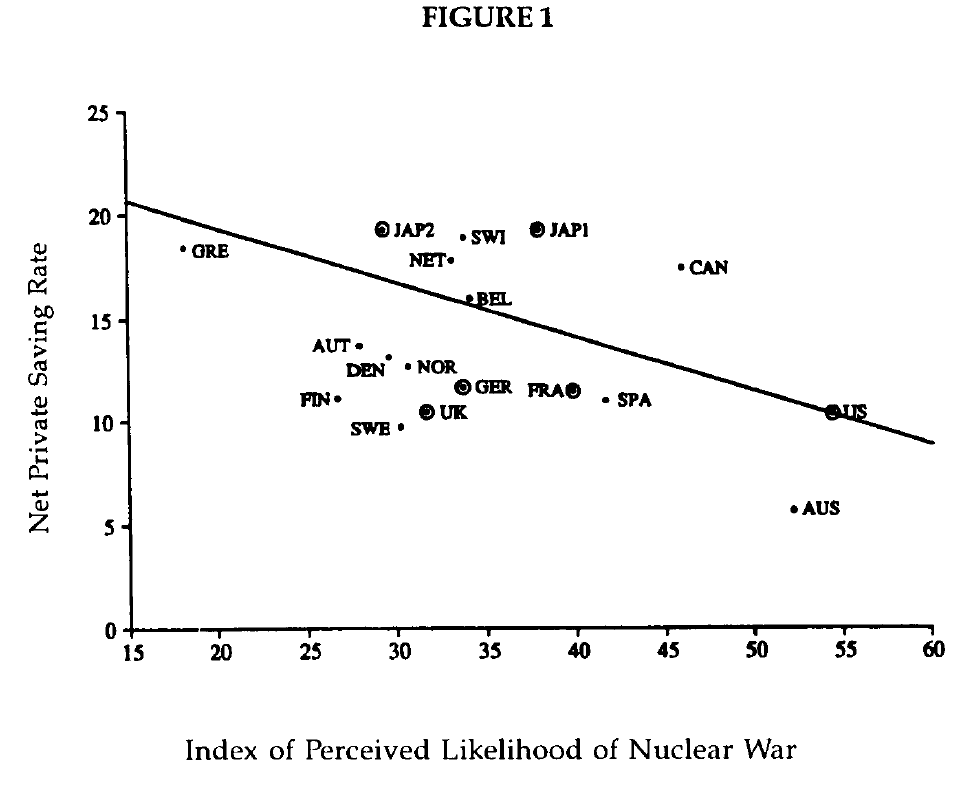
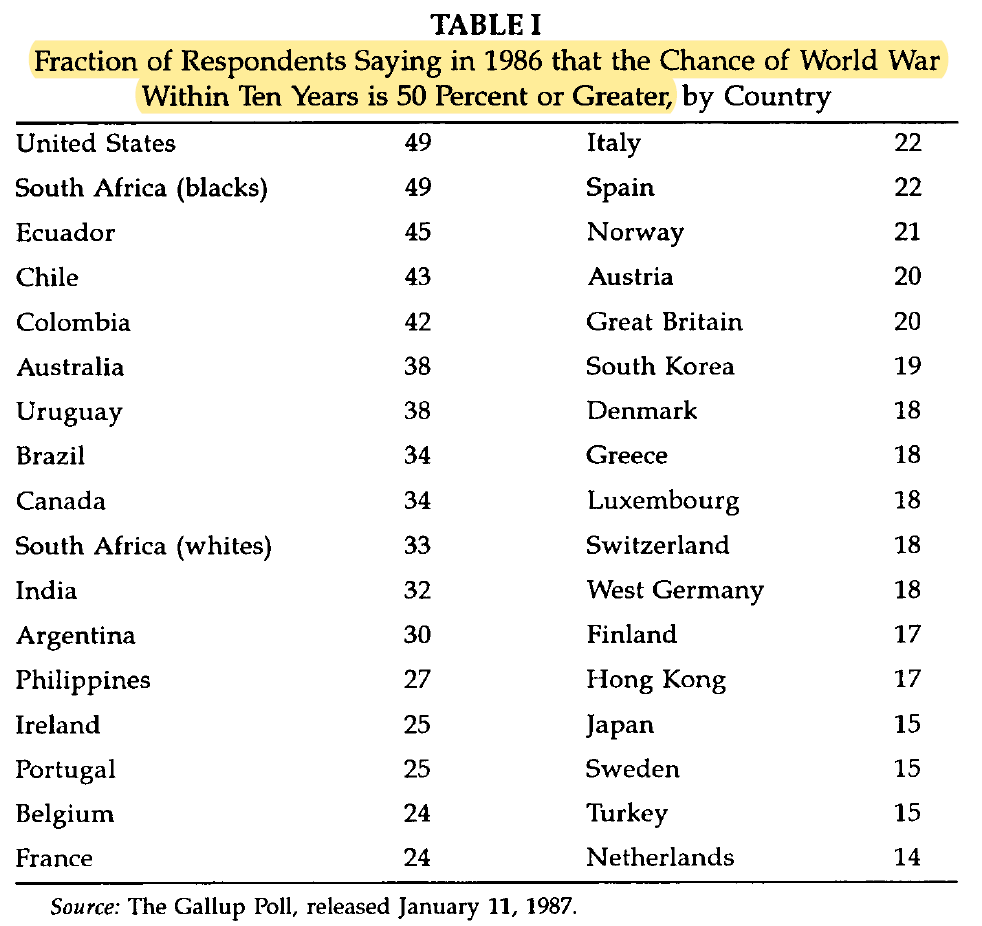
Look at 19 OECD countries
-
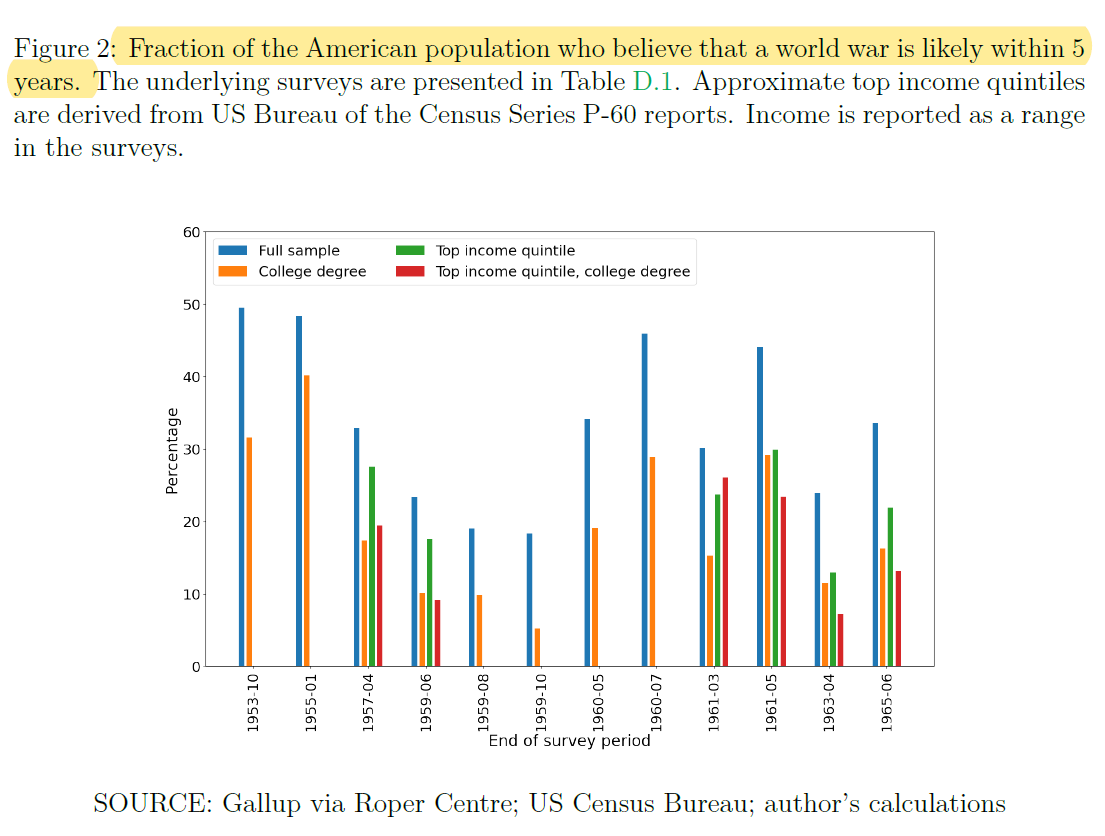
Gallup survey data from 1981-1984: perceived likelihood of nuclear war is negatively correlated with savings rate
-
Looks like it’s really just driven by three outliers lmao
-
“A 10 percent increase in the fraction of the population that believes a world war is likely is associated with a decline of 4.1 percentage points in the net private saving rate”
2. MARKETS AND WARS
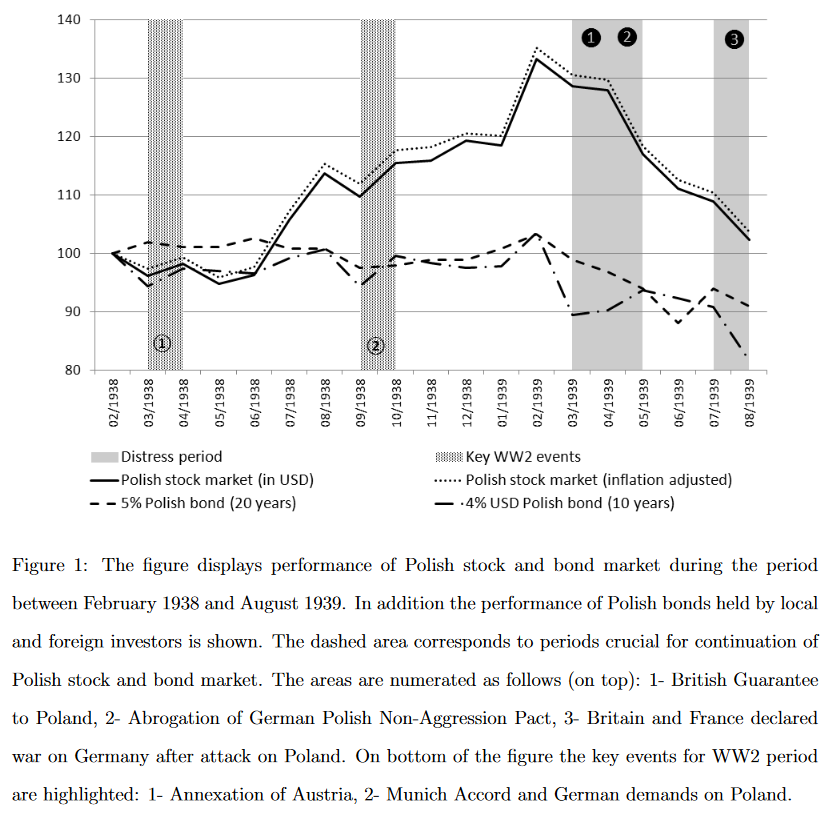
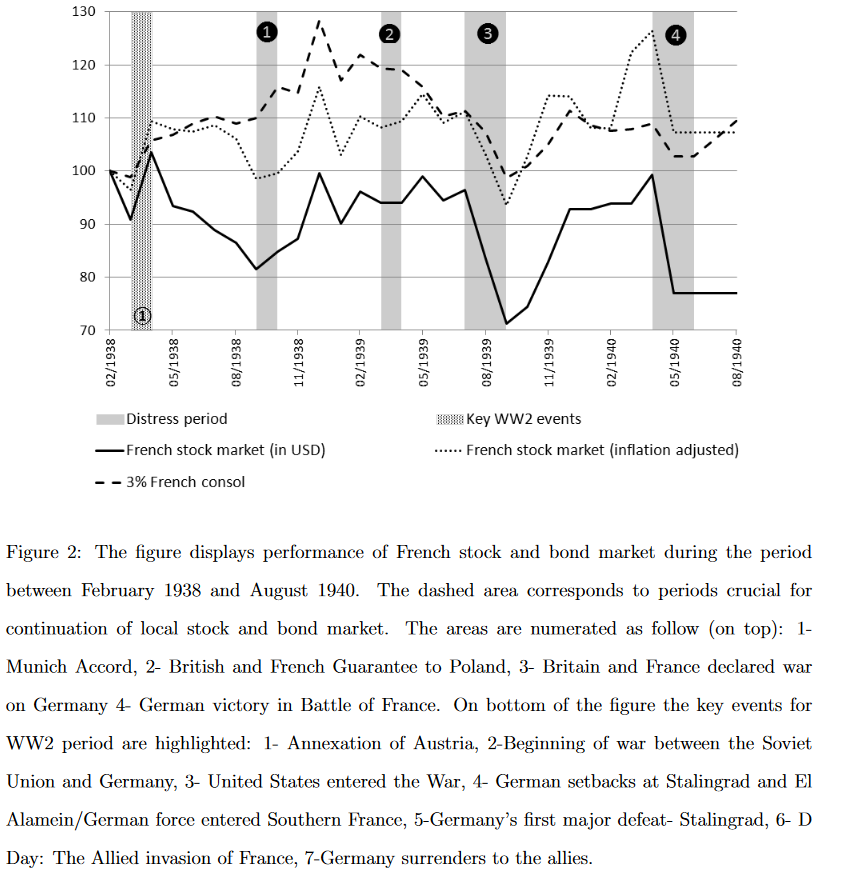
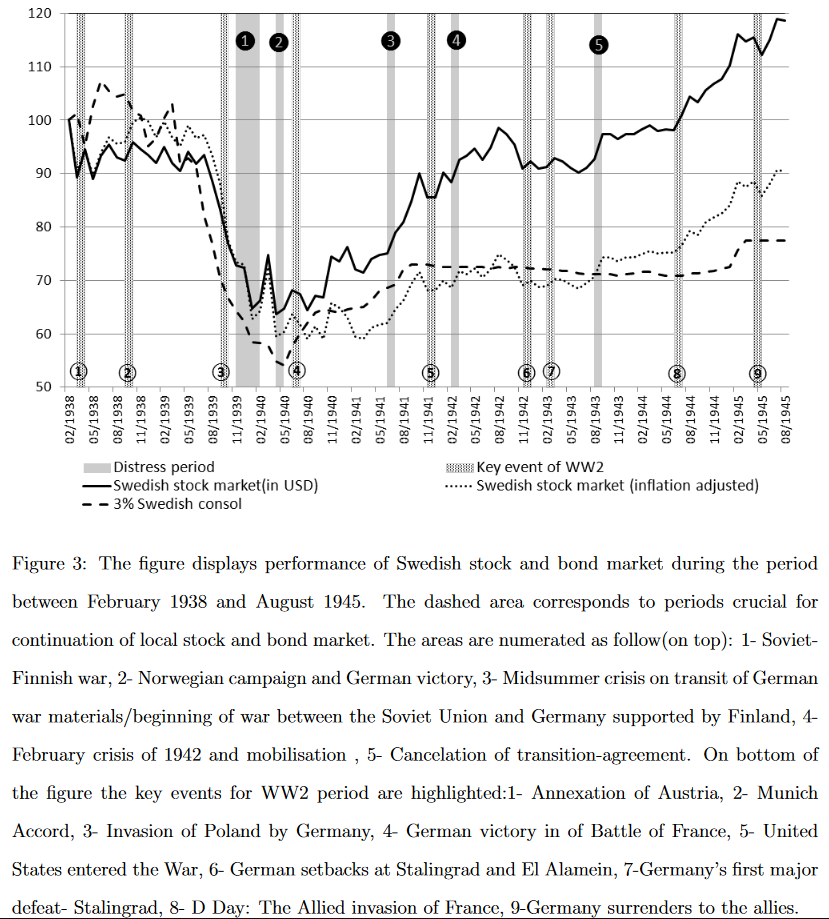
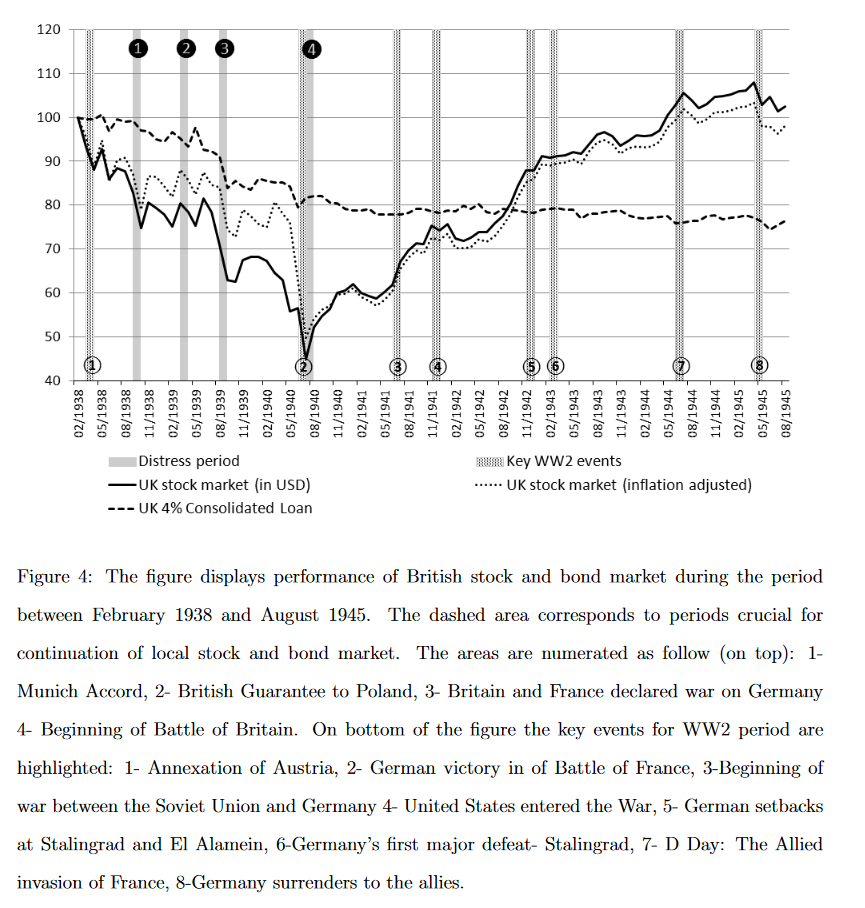
Bialkowski and Ronn (2017)
-
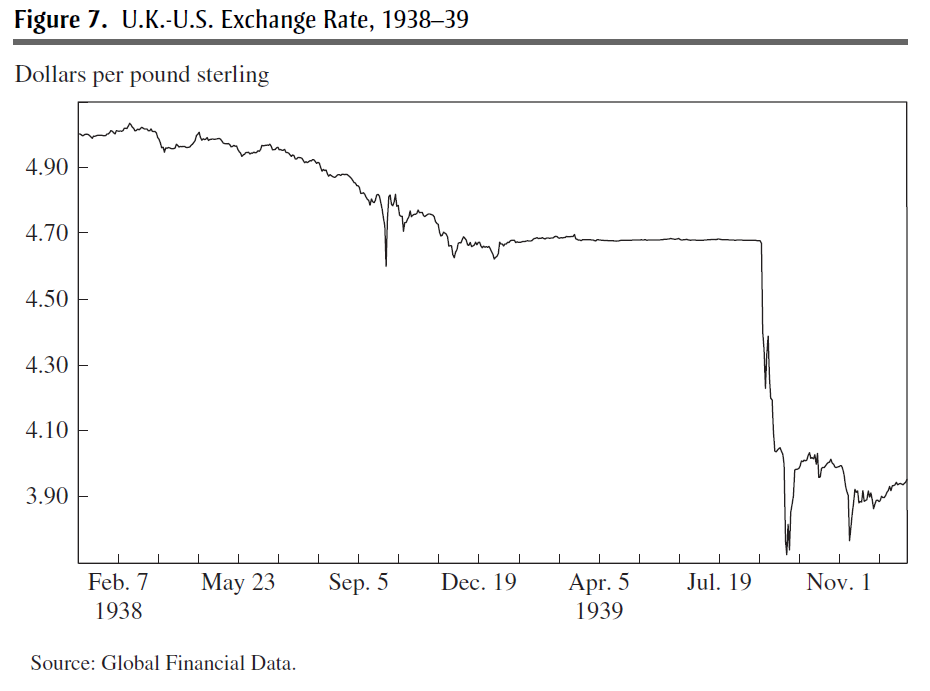
Polish and French capital markets did not(?) predict apocalypse in September 1939
-
My interpretation:
-
(1) these are only traded prices!
-
(2) there is probability of recoverability, as seen in other wars
-
(3) if(?) these are nominal bonds, then declines also reflect prospects for (hyper)inflation
Ferguson (2008)
-
Mostly narrative evidence of financial markets for WWI, WWII, early Cold War
-
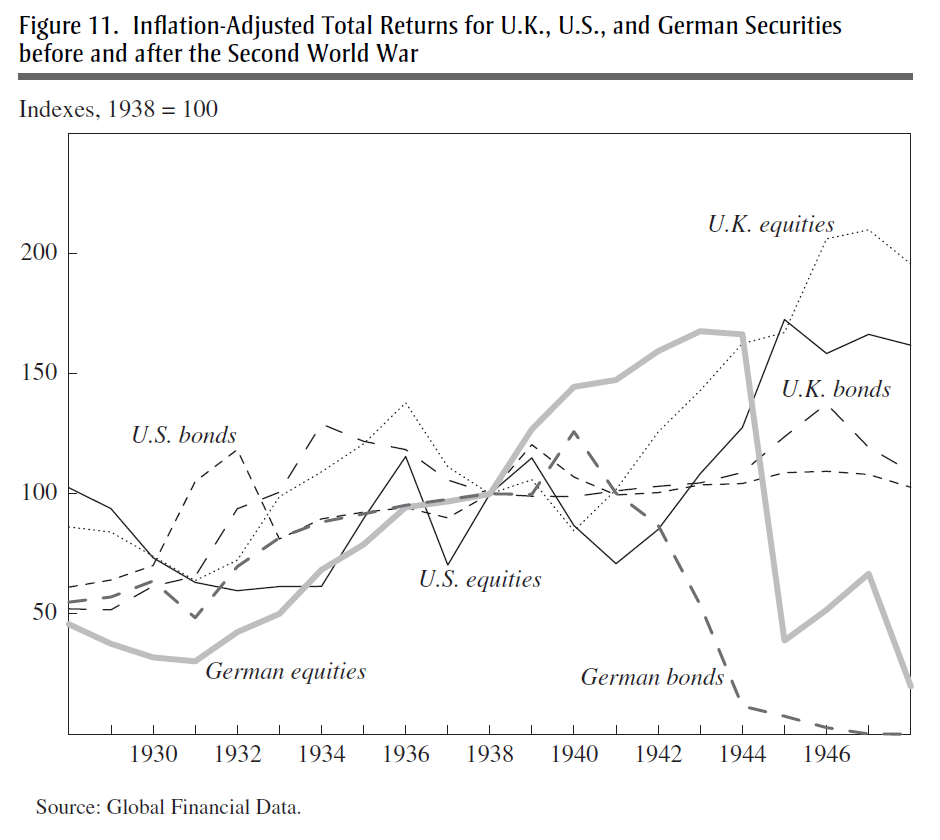
“The main conclusions of the paper are the following. The First World War was not anticipated. The right decision for investors would have been to shift into U.S. assets and out of U.K. assets before 1913. Instead investors got severely hit. The Second World War was, on the other hand, fully anticipated. Given the experience of the First World War, the smart money seems to have shifted from U.K. into U.S. assets in the 1930s. Interestingly, however, the financial consequences of the Second World War were very different from those of the First: U.K. assets consistently outperformed U.S. assets. When the Korean War broke out, investors acted on the basis of their experience in the Second World War”
-
Data from GFD
-
Need to figure out: is he using total returns, priced in GBP…?
-
SEE ALSO: Ferguson (2006), for 1848-WWI (‘WWI was not expected by bond markets’)
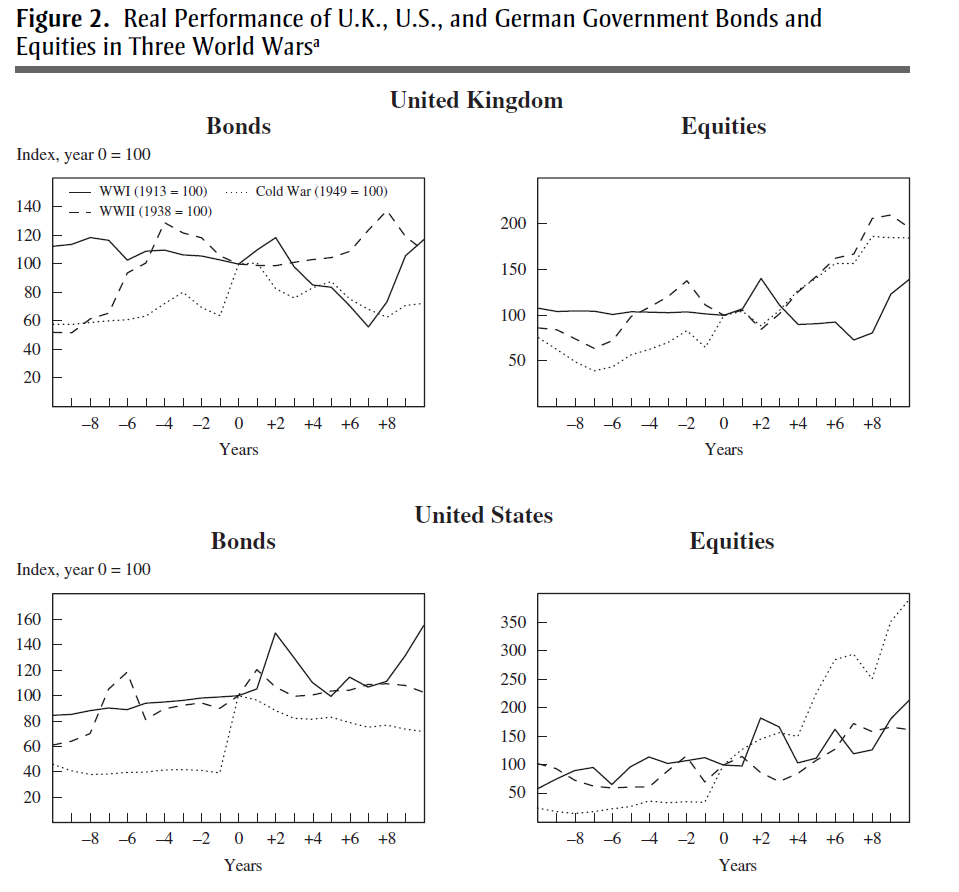
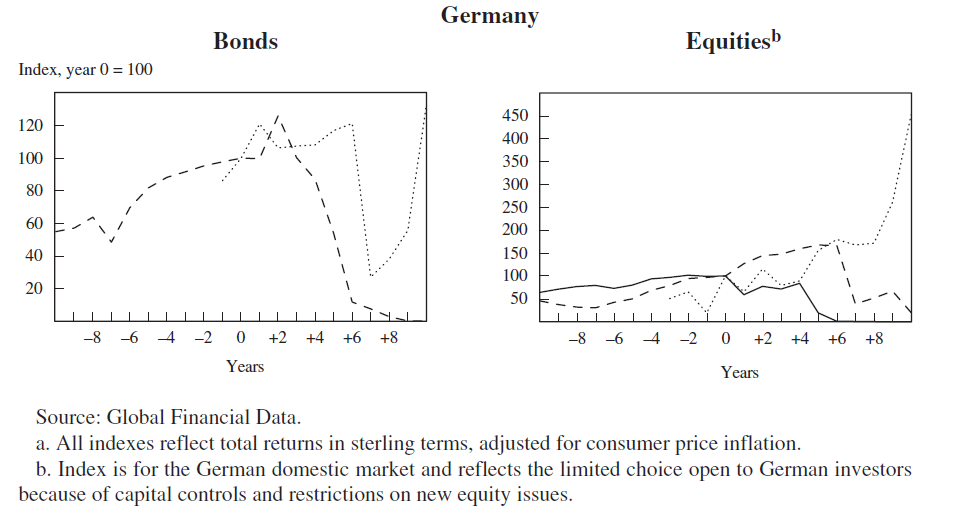
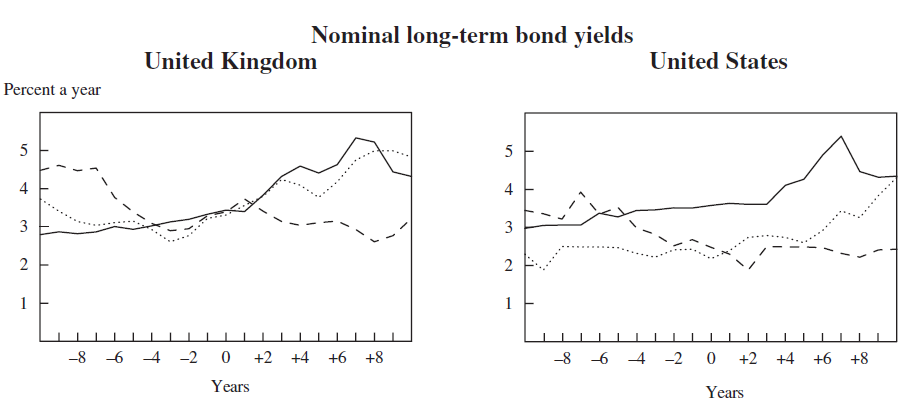
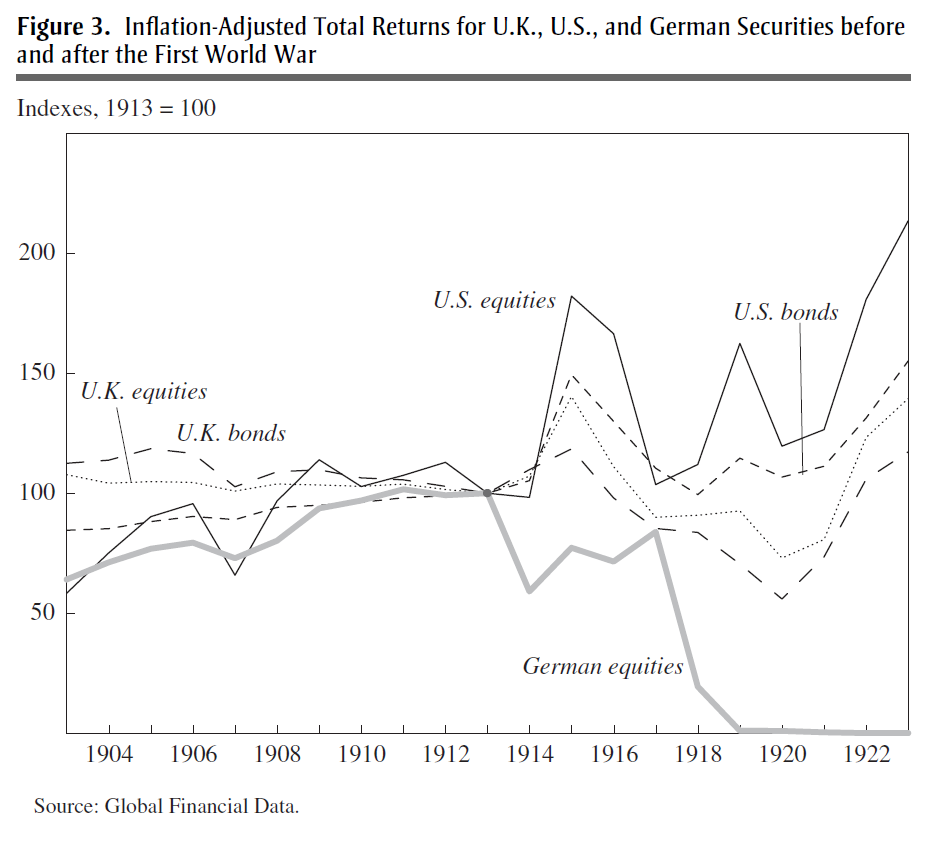
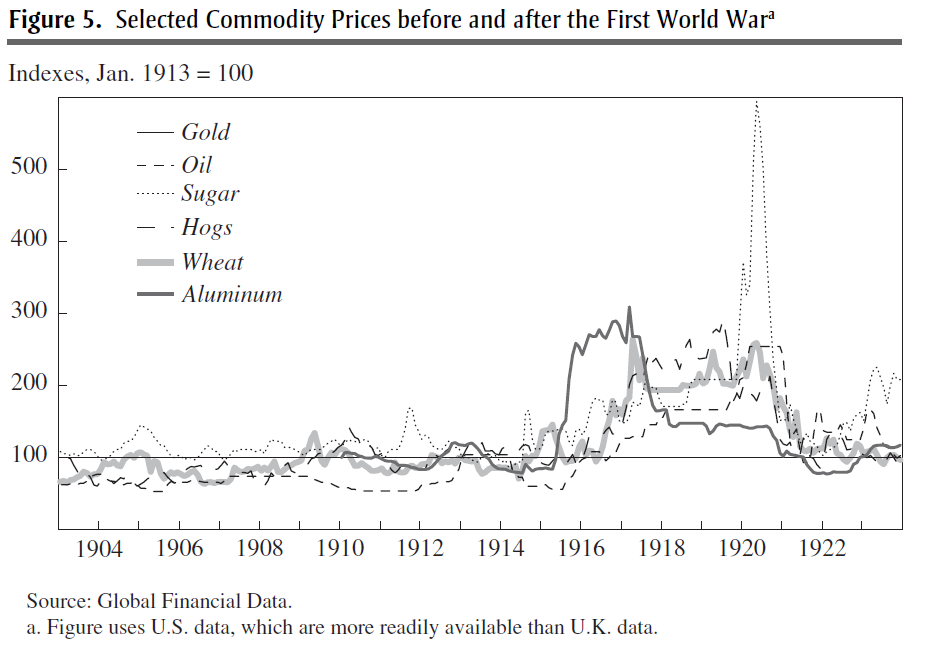
- Is this real or nominal?
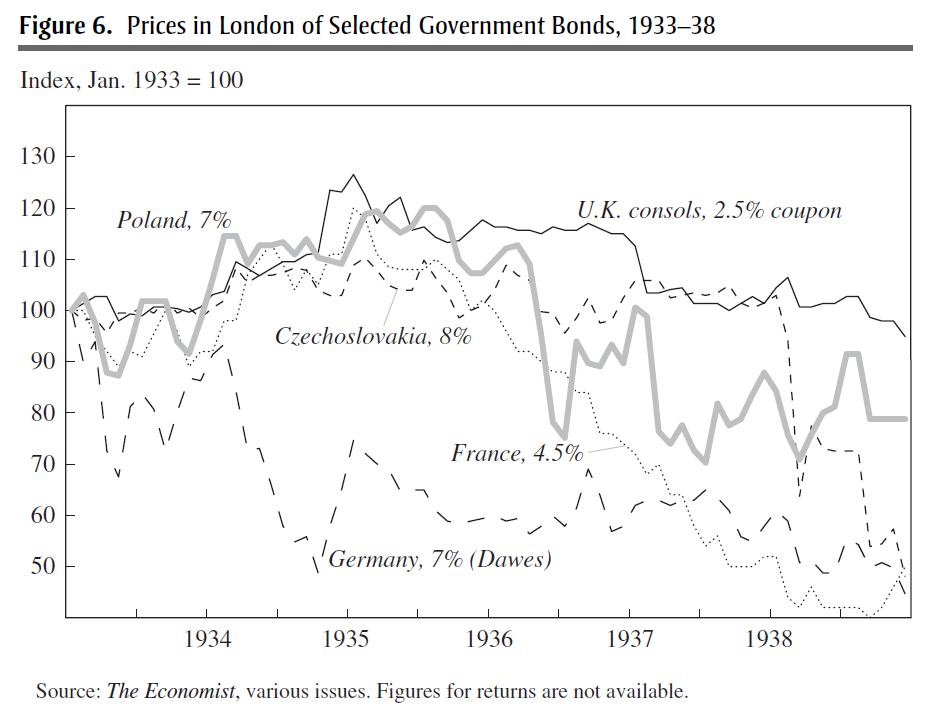
- “Financial market data support the proposition that, pace Keynes, investors had learned their history lesson. They understood, for example, that anything that raised the probability of another war was a signal to reduce their exposure to continental securities and currencies. As figure 6 shows, German bonds had sold off in London almost from the moment of Hitler’s appointment as chancellor of the Reich on January 30, 1933.70 French bonds began to slide downward in 1935, even before the remilitarization of the Rhineland. There was also a significant increase in the volatility of Polish bonds from the spring of 1936 and Czech bonds from the spring of 1938. Needless to say, many factors were at work in the bond market of the 1930s. The world was emerging from a deep depression”
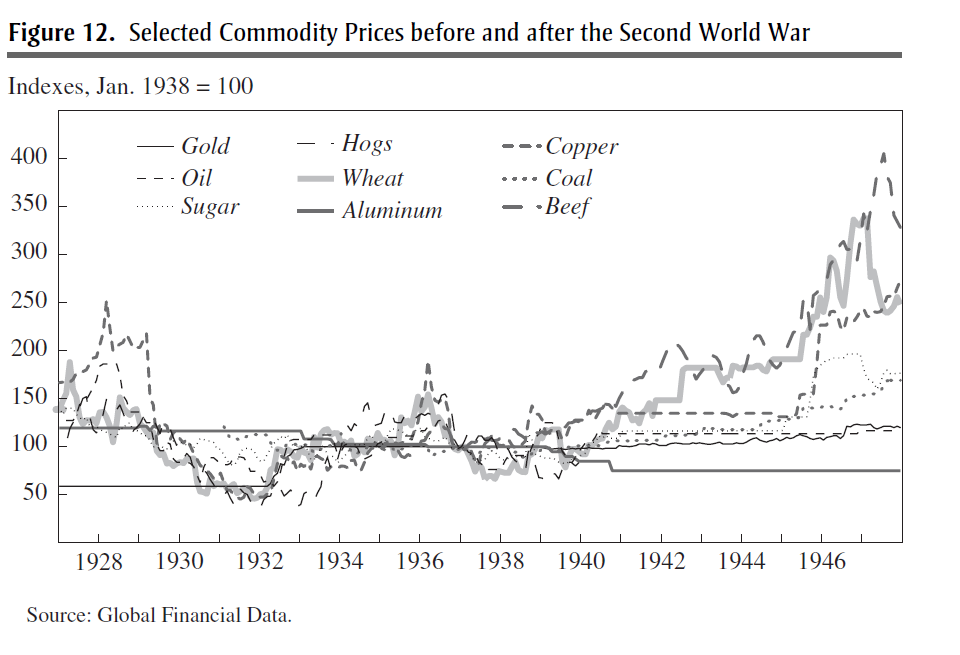
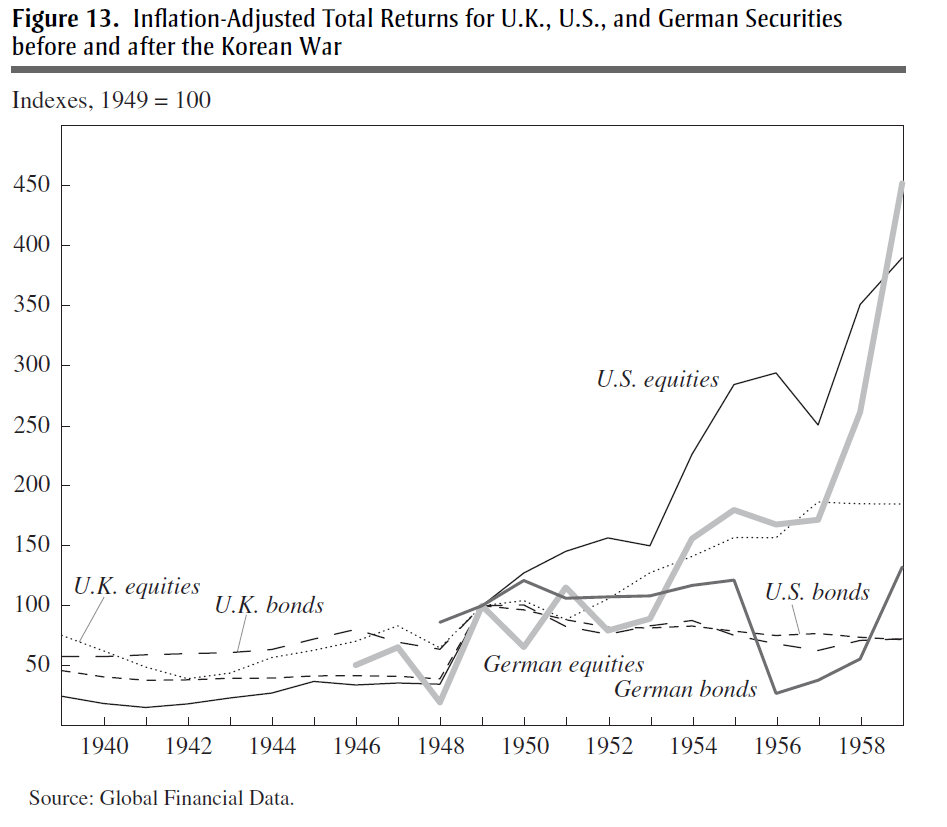
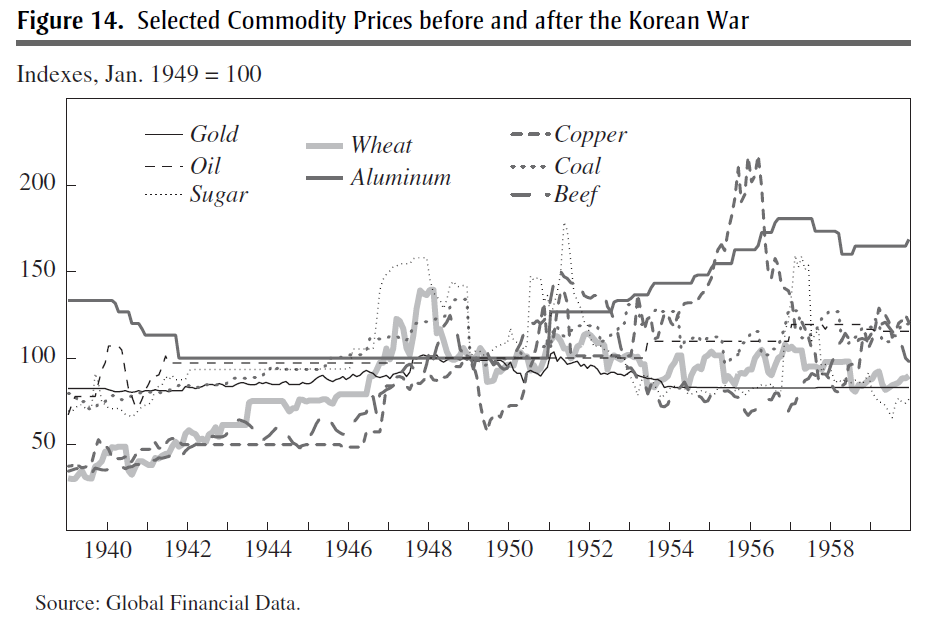
Hirshleifer, Mai, and Pukthuanthong (2023)
Rexer, Kapstein, and Rivera (2022)
Neely (2024)
3. CUBAN MISSILE CRISIS
Finer (2022)
-
2022 UChicago JMP
-
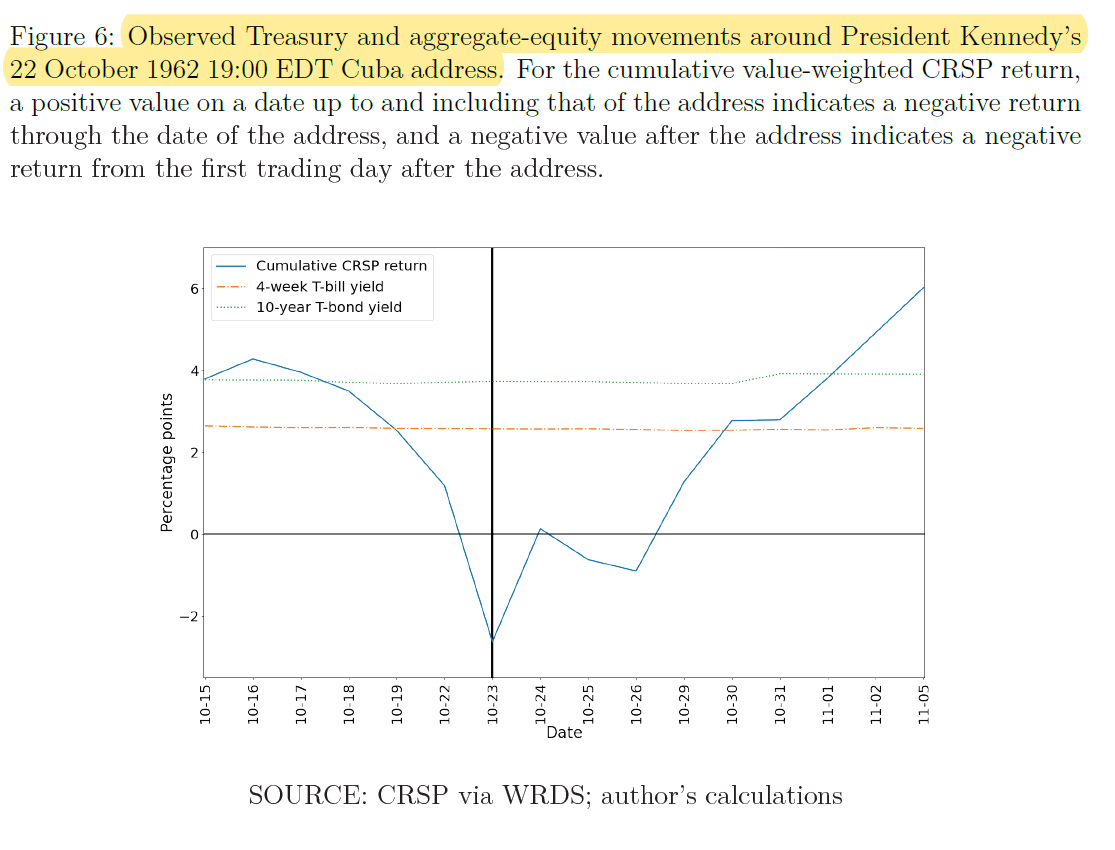
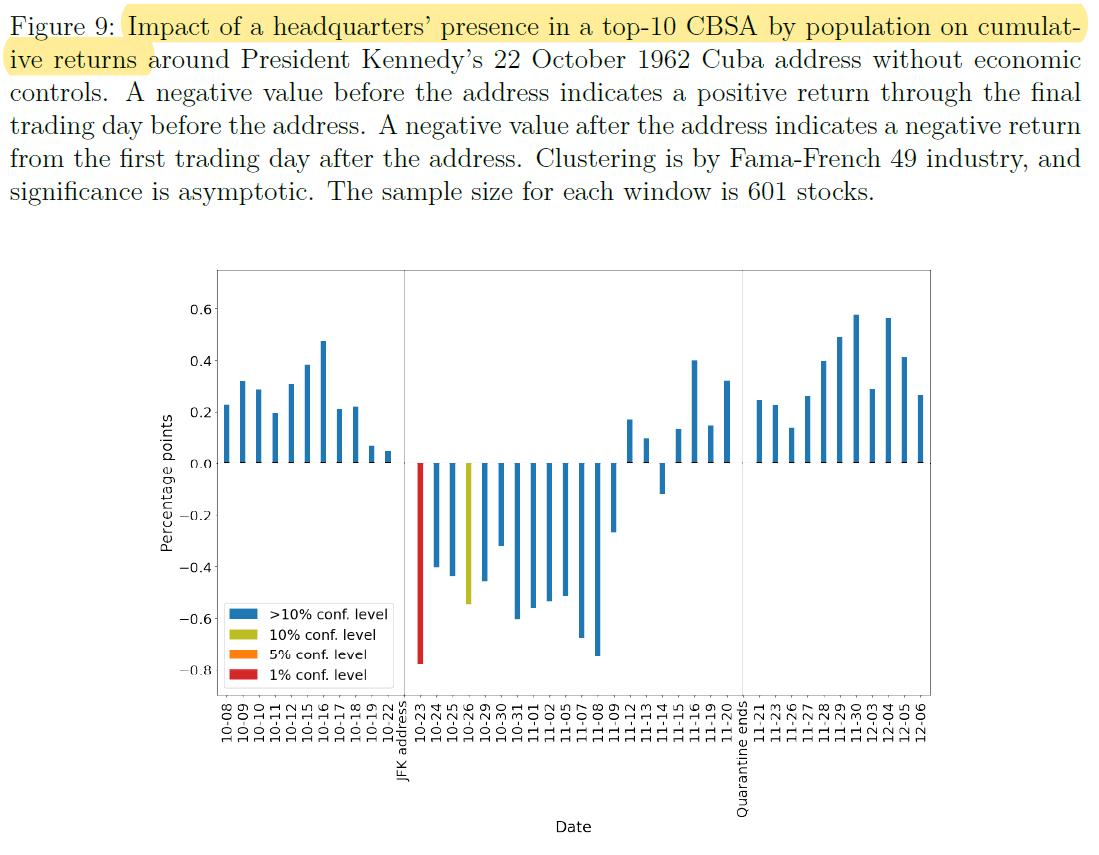
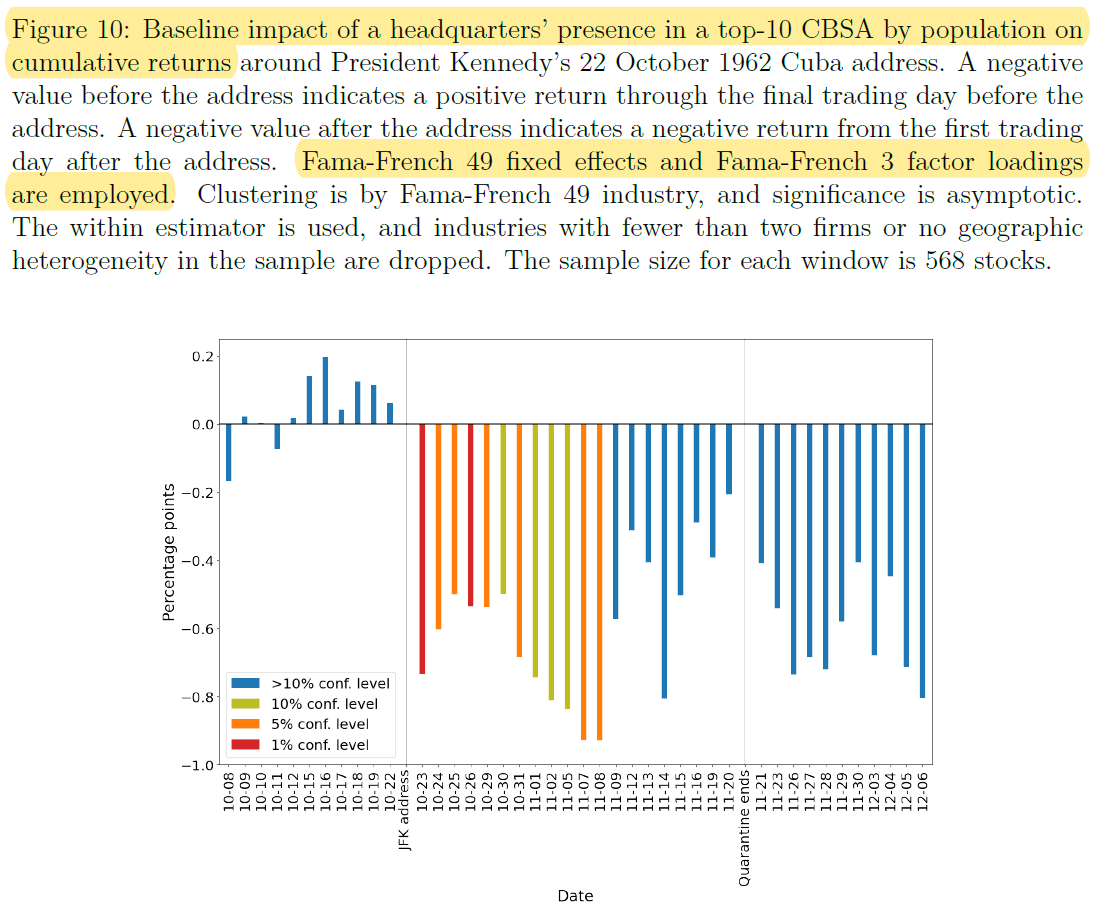
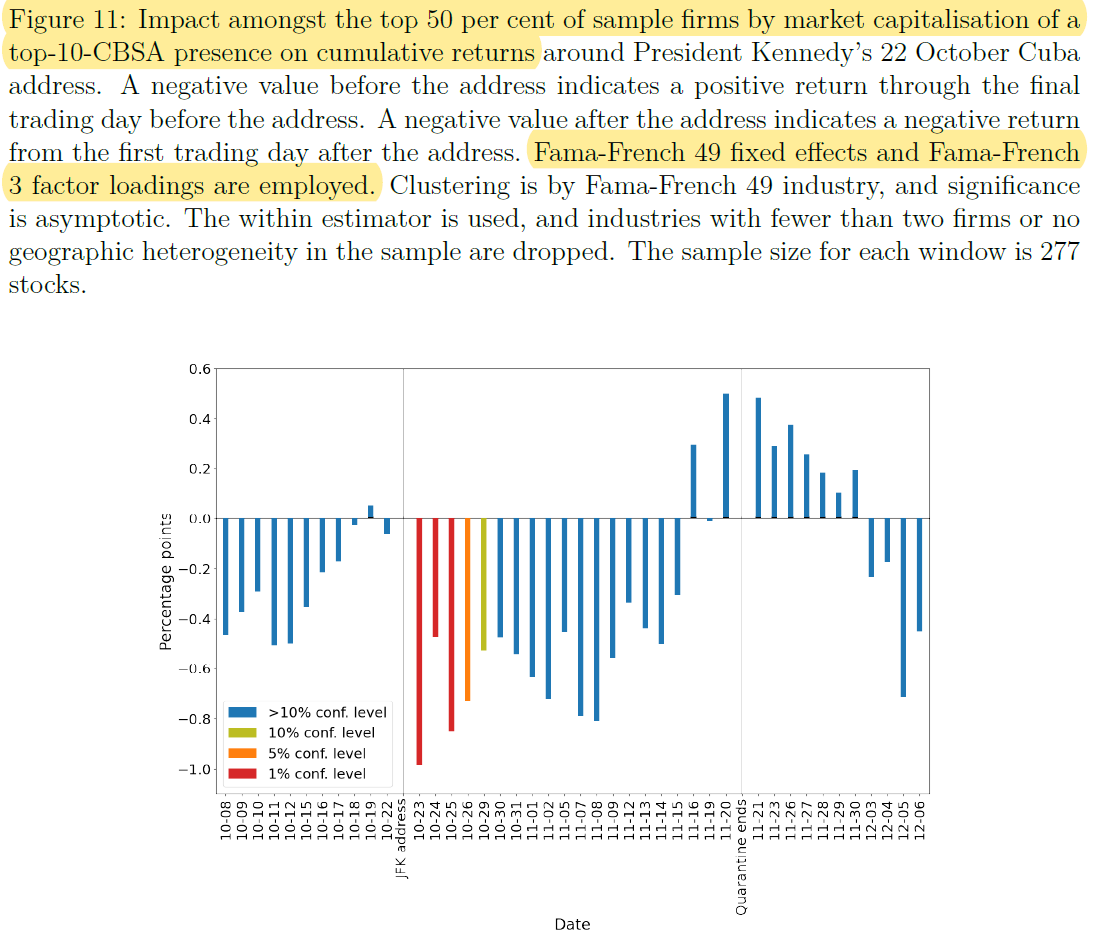
Cross-sectional asset pricing during Cuban missile crisis of more versus less exposed stocks
-
Look at companies headquartered in 10 most populous US cities
-
Argue that (and show some narrative evidence from the time suggestively that) proximity to Cuba plausibly not that important, since Soviet missiles could hit anywhere anyway
-
Aggregate market fell by 2.6%; these riskier stocks fell an additional 0.7pp (t=3.9)
-
Gap recovers as crisis abated
-
Robust to removing FF3 loadings
-
Not driven by a single municipal area
-
Also abnormally low returns for FL and TX firms
-
Placebo tests: eh
-
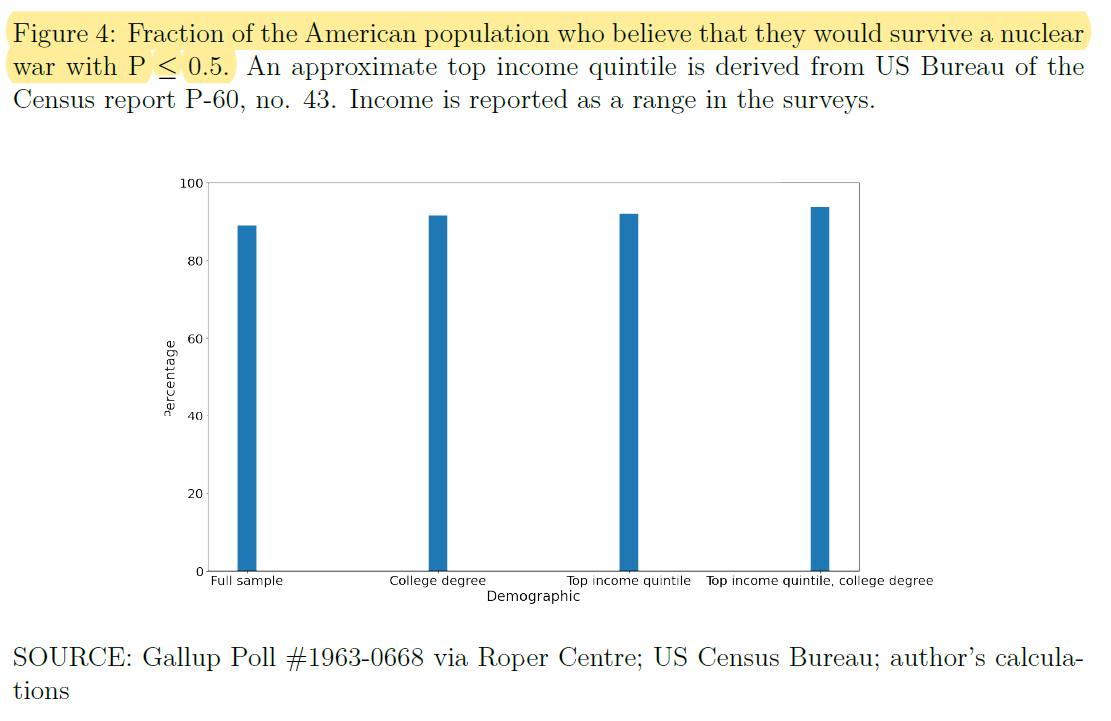
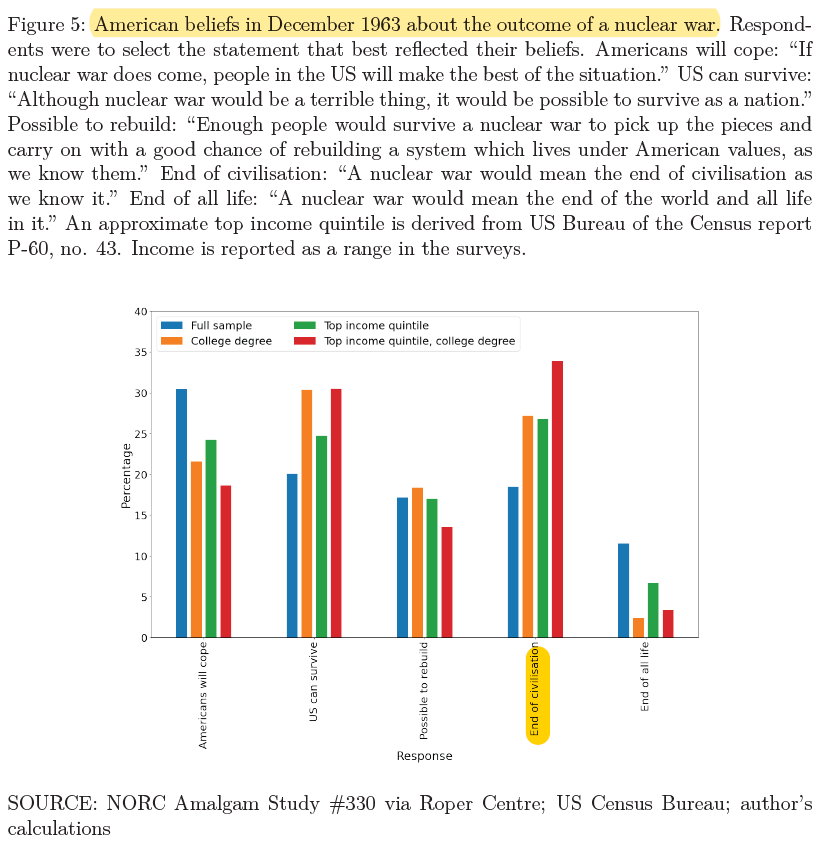
Structurally/calibrating to standard risk aversion: survey evidence of beliefs of nuclear risk do not reconcile with the small change in asset prices
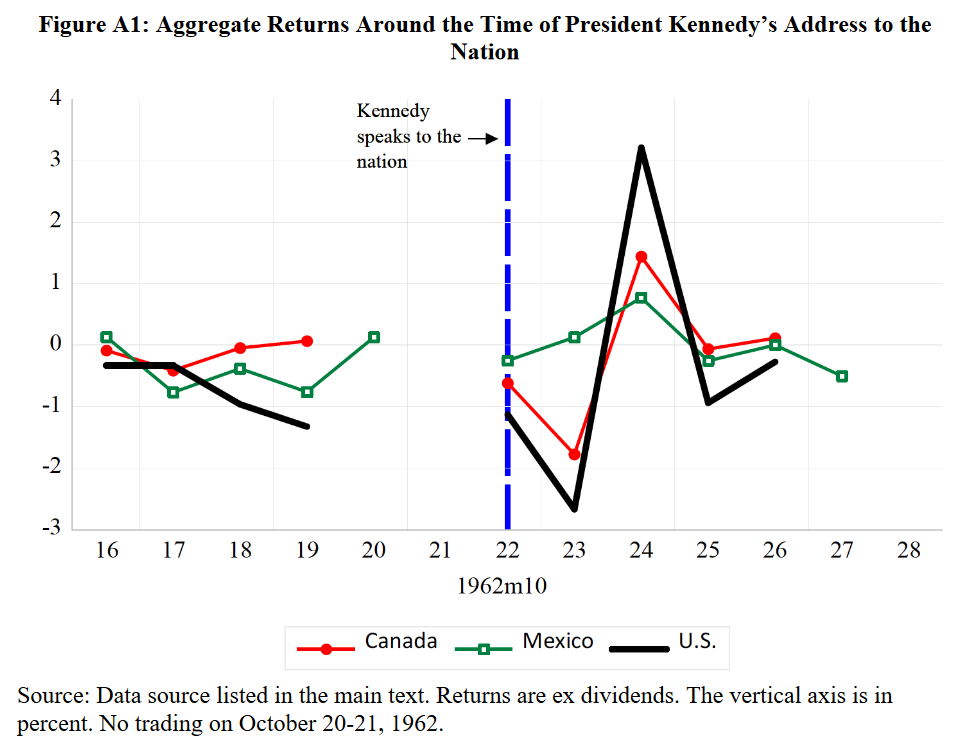
Burdekin and Siklos (2022)
-
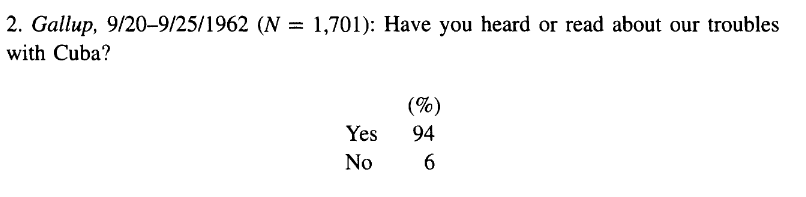
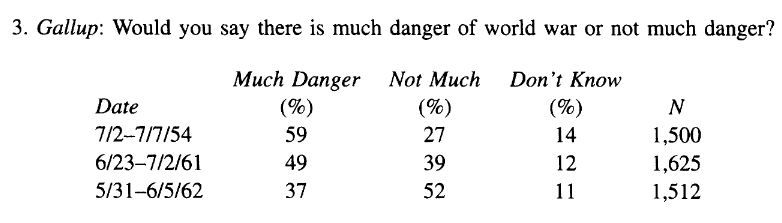
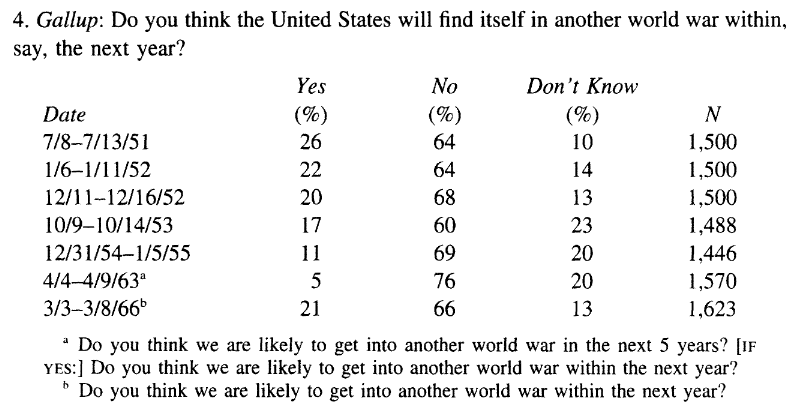
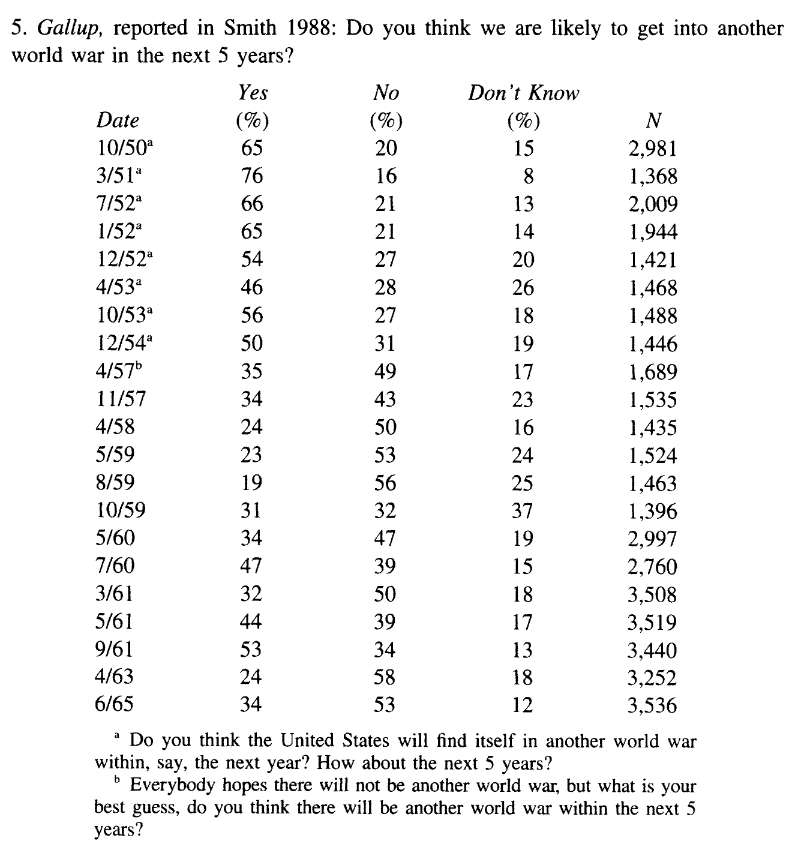
“It appears then that markets assigned a very small risk to the crisis leading to the use of nuclear arsenals despite President Kennedy’s pessimism at the height of the Cuban Missile Crisis. Gallup polls around the time of the crisis and soon after (Smith 2003) suggest that, whereas the public was very aware of tensions with Cuba and the financial implications, with a majority (59%) believing that Cuba was a threat to world peace, the danger of a war was nevertheless seen to be very low (5% by February 1963).”
-
GFD for SP500 data; hand-collect (?!) data on daily equity prices in Canada/Mexico
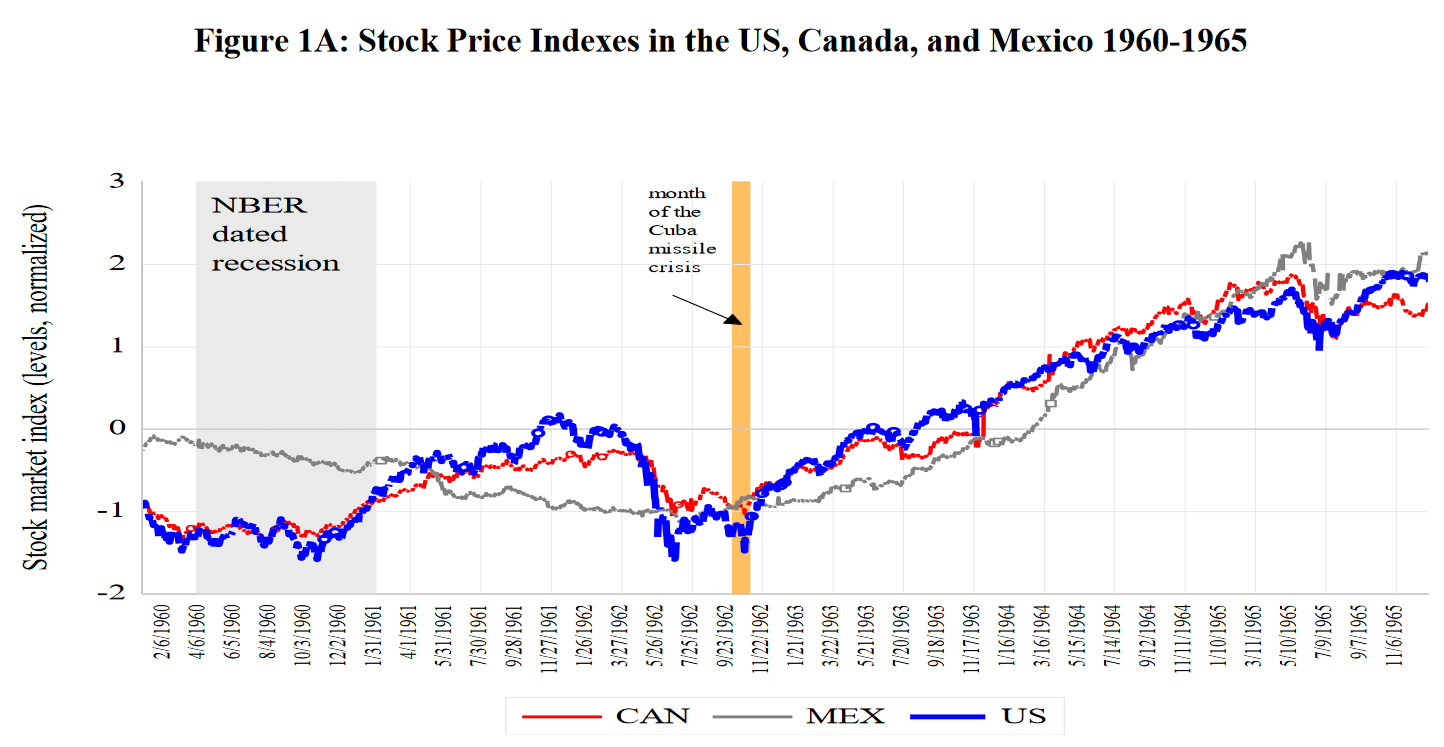
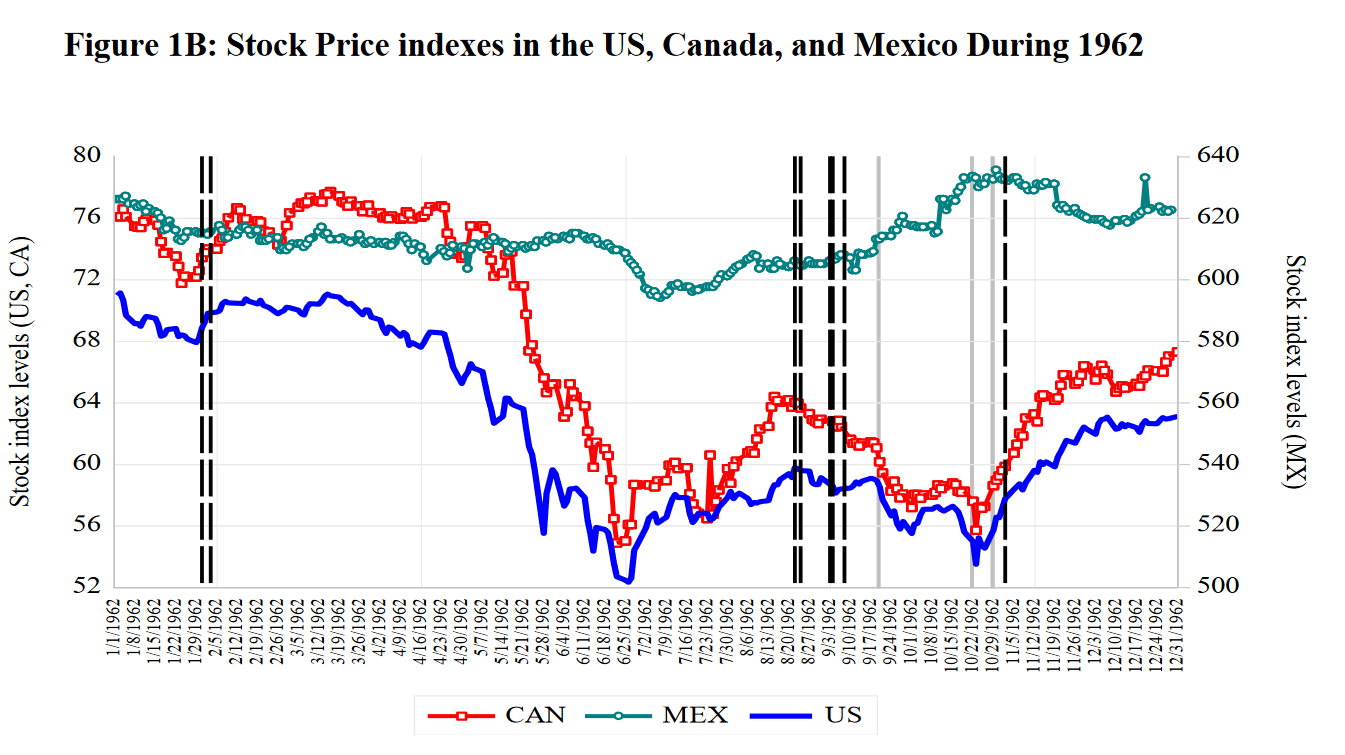
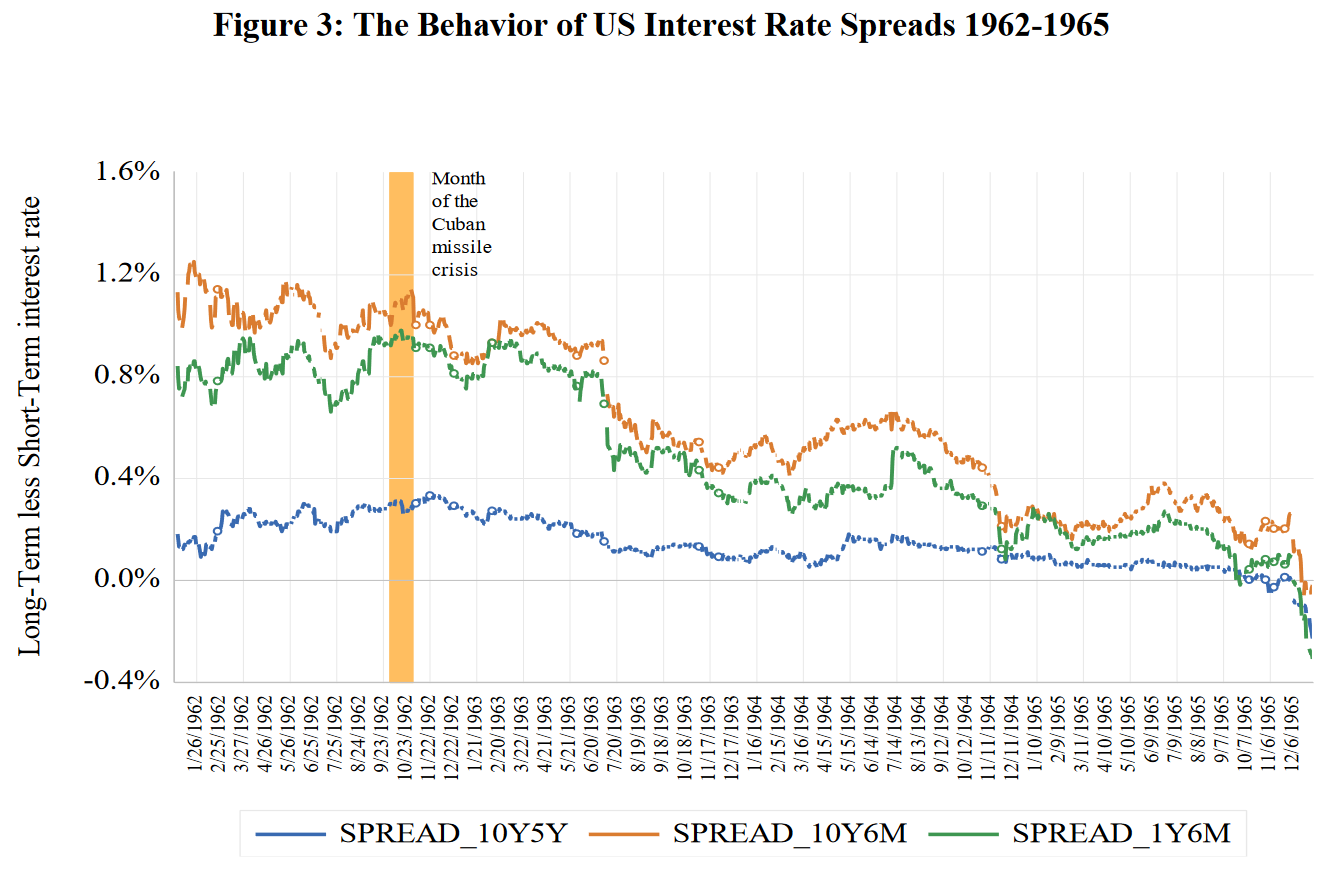
- Why the fuck are you only showing the spreads?
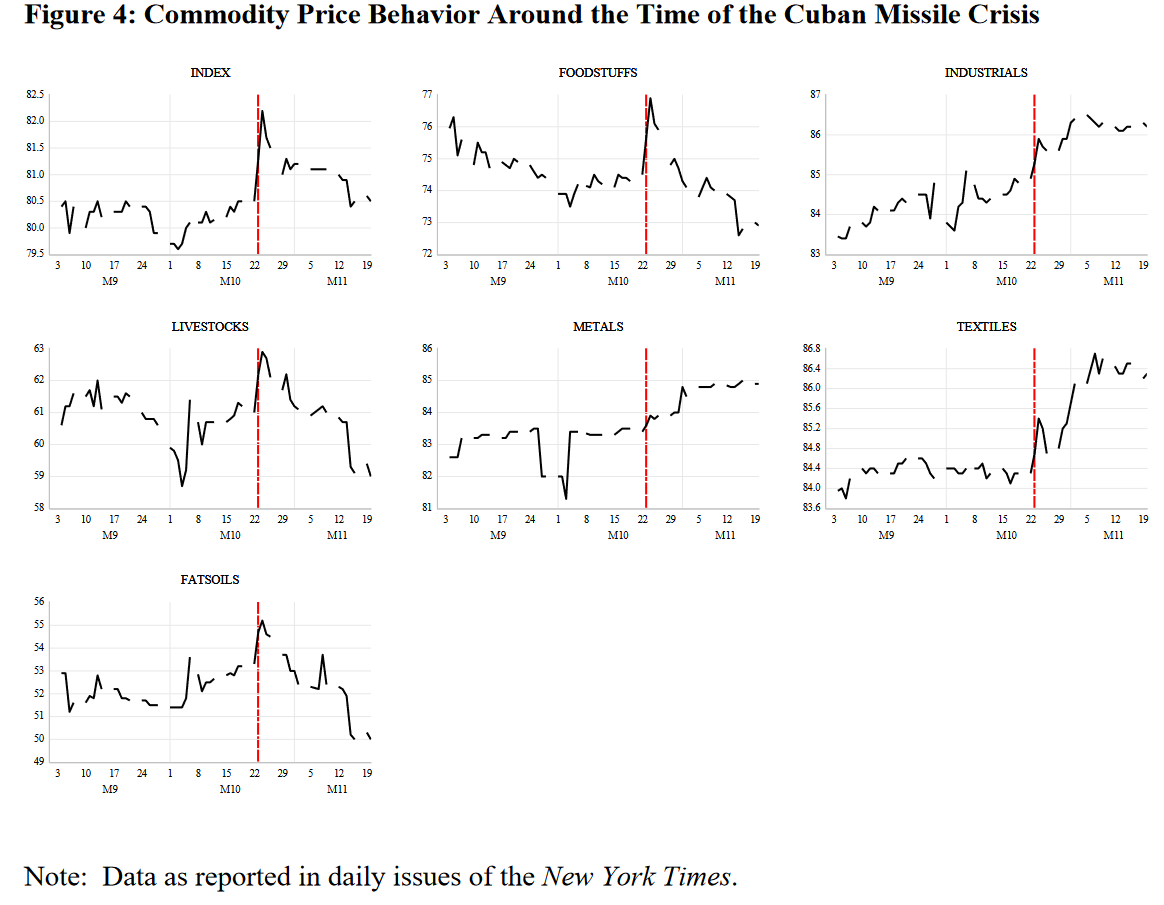
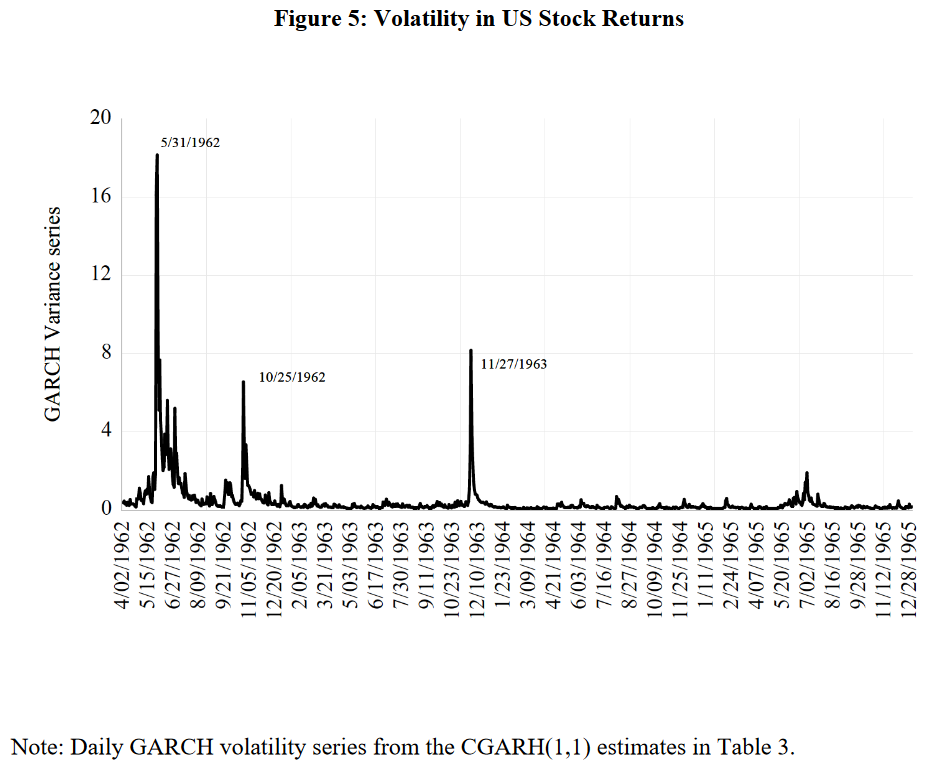
Raschky and Wang (2017)
- “We exploit the timing of the Cuban Missile Crisis and the geographical variation in mortality risks individuals faced across states to analyse reproduction decisions during the crisis. The results of a difference-in-differences approach show evidence that fertility decreased in states that are farther from Cuba and increased in states with more military installations. Our findings suggest that individuals are more likely to engage in reproductive activities when facing high mortality risks, but reduce fertility when facing a high probability of enduring the aftermath of a catastrophe.”
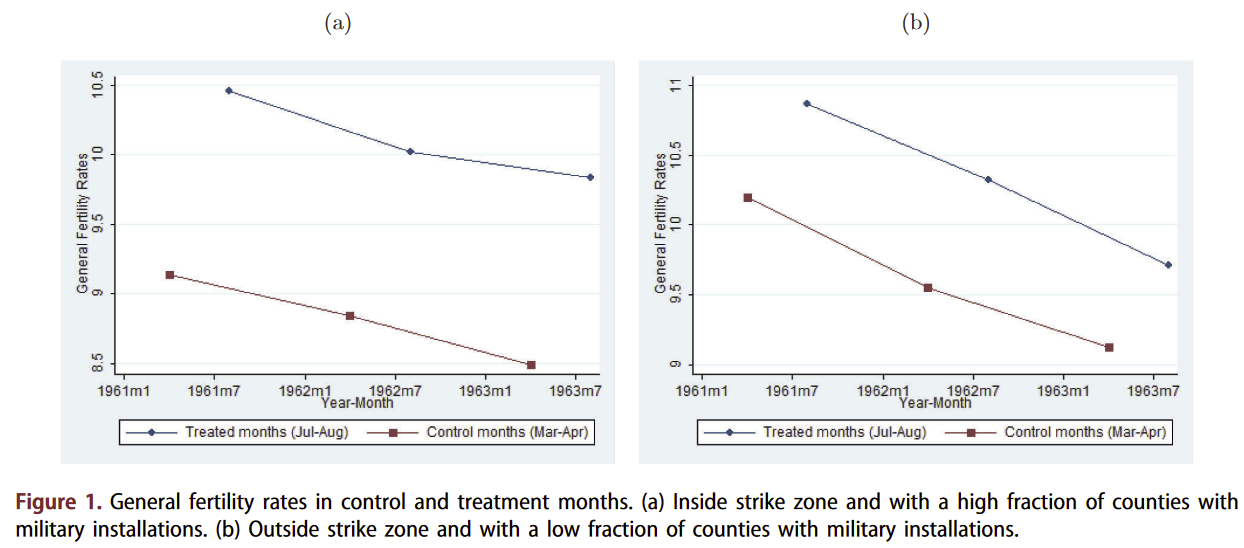
- 🥴🥴🥴🥴🥴🥴🥴🥴
Smith (2003)
-
Note Cuban missile crisis was Oct 15 – Nov 20, 1962
-
As summarized in Burdekin and Siklos (2022): “Gallup polls around the time of the crisis and soon after (Smith 2003) suggest that, whereas the public was very aware of tensions with Cuba and the financial implications, with a majority (59%) believing that Cuba was a threat to world peace, the danger of a war was nevertheless seen to be very low (5% by February 1963).”
“What do you think is the most important problem facing the country today?”
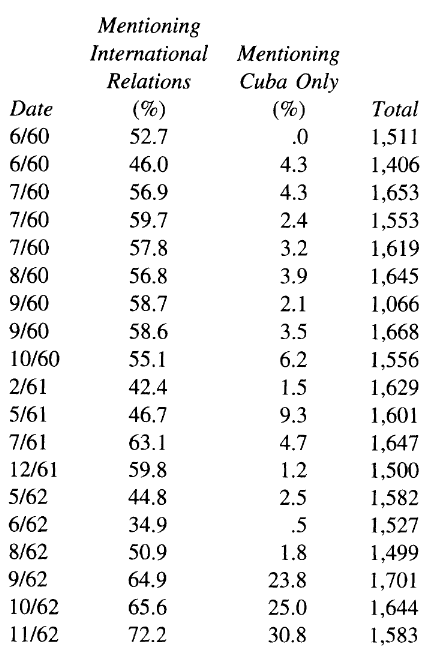
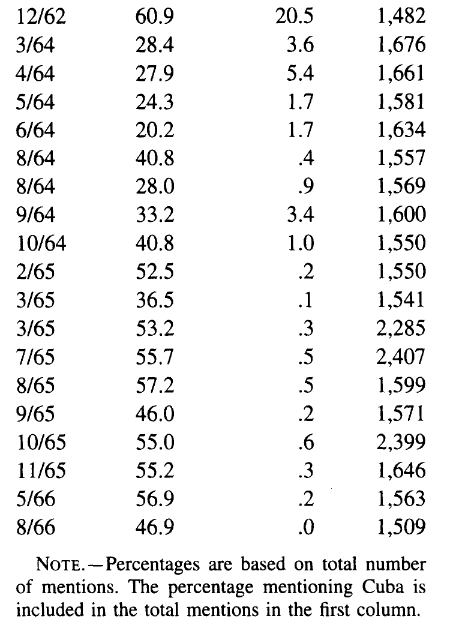
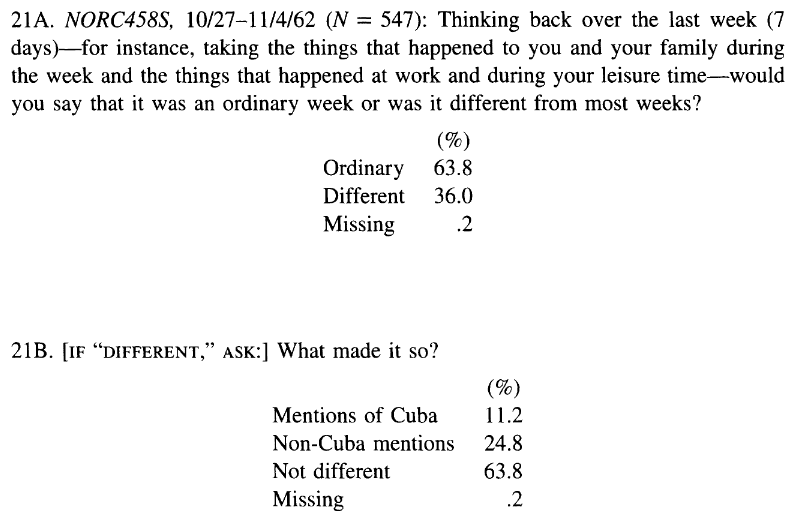
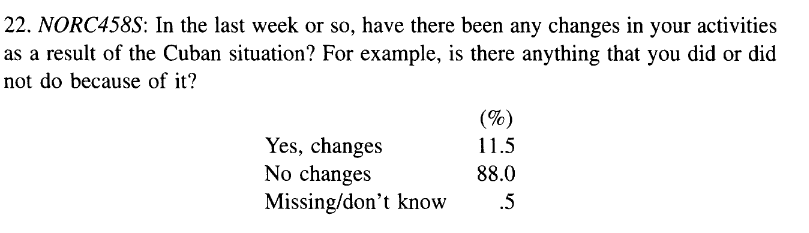
From Finer (2022):
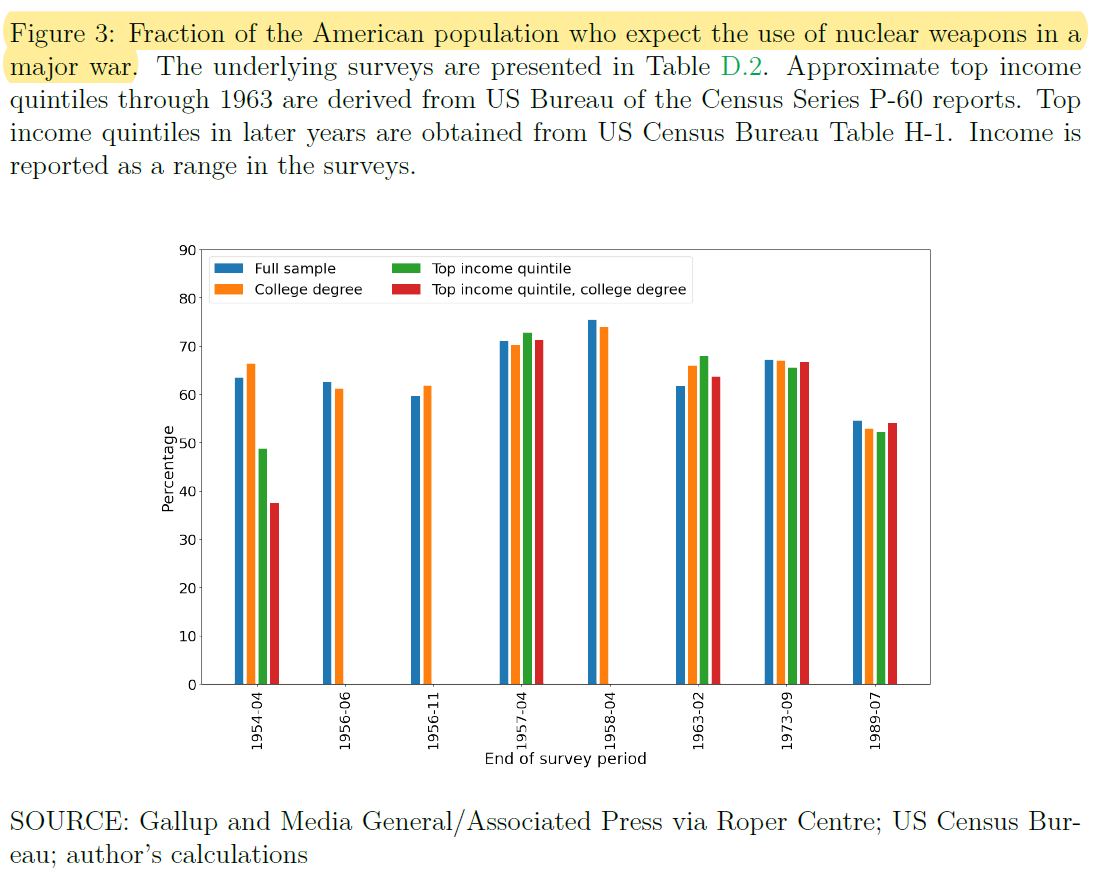
Newspaper articles
- Lots more digging could be done here, mostly for fun
Context:
-
JFK speech was Monday Oct. 22, 1962 at 7pm
-
News may have leaked in months prior though
Monday 10/22
Tuesday 10/23
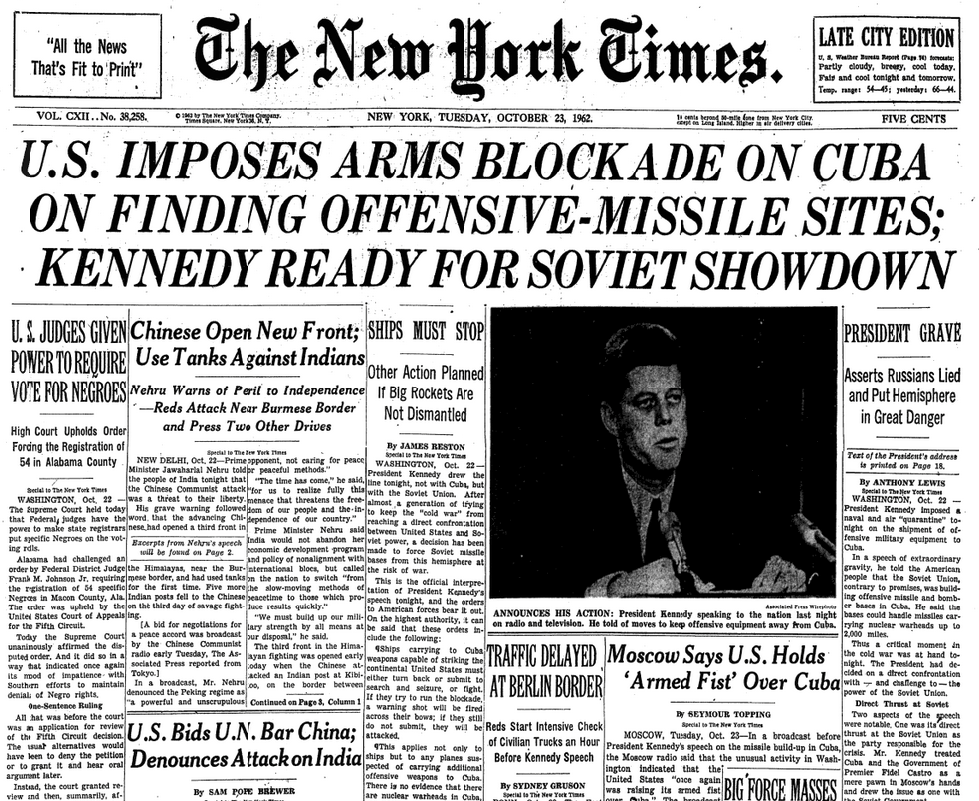
Wednesday 10/24 (reporting on Tuesday 10/23)
-
Business section(?): “Futures market soars with crisis”
-
“The cold war came close enough to the hot stage this week to make prices skyrocket on the commodity futures exchanges, which have been somewhat casual about crises in recent years.”
From Finer:
- The first financial reporting in The New York Times after the address was filled with references to the Crisis, e.g., Rutter (1962b) and Nuccio (1962), and, days later on 26 October, The New York Times notes that observers “believe that at least in the near-term future the course of the market would be decisively influenced by international developments…” (Rutter (1962a)). Kraus (1962c) reports that “the market practically ignored business and financial news” at the beginning of the Crisis. Writing shortly before the lifting of the quarantine, Abele (1962a) credits the Crisis with market gyrations over the previous weeks. “Fearful of a belligerent Soviet reaction to the American challenge, frenzied investors created a near Panic as they rushed to sell their securities… The morale of the nation rallied strongly at the success of the American challenge. Spirits along Wall Street rose along with those of the rest of the country. So did stock prices” (Abele (1962a)).
4. RARE DISASTERS
Pindyck and Wang (2013)
-
- Structural model of catastrophic-but-not existential risk (fraction of capital shock is destroyed)
-
- Calibrate model to US postwar equities
-
- Back out implied WTP for catastrophe insurance
Rare disaster lit: take probability of rare disasters from the data, estimate risk premium using a model;
Here: take equity returns from the data, estimate disaster probability using a model
Details:
-
Model: EZW preferences, AK technology, with quadratic capital adjustment costs
-
Calibration:
-
Risk aversion of 3.1
-
Catastrophic risks follow Pareto distribution
-
Shocks arrive on average every 1.4 years, with a mean loss of 4%
-
Implying e.g.:
-
Probability of loss in any given year is 8.7%
-
Probability of loss in any given year is 2.3%
-
=57% chance of at least one such event over a 50-year period
-
Probability of loss in any given year is 0.6%
To eliminate all shocks, society would accept a permanent 50% reduction in consumption (first row)
To eliminate all shocks 15%, society would accept a permanent 7% reduction in consumption
- Table 5
Chen, Joslin, and Tran (2012) point out that, if there is disagreement among investors, then asset prices will reflect the disaster probabilities of optimists! And therefore will be underestimates of these quantities
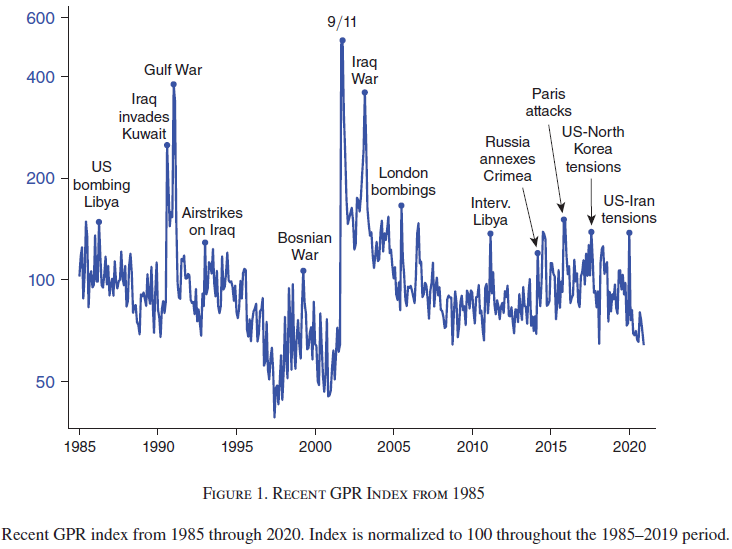
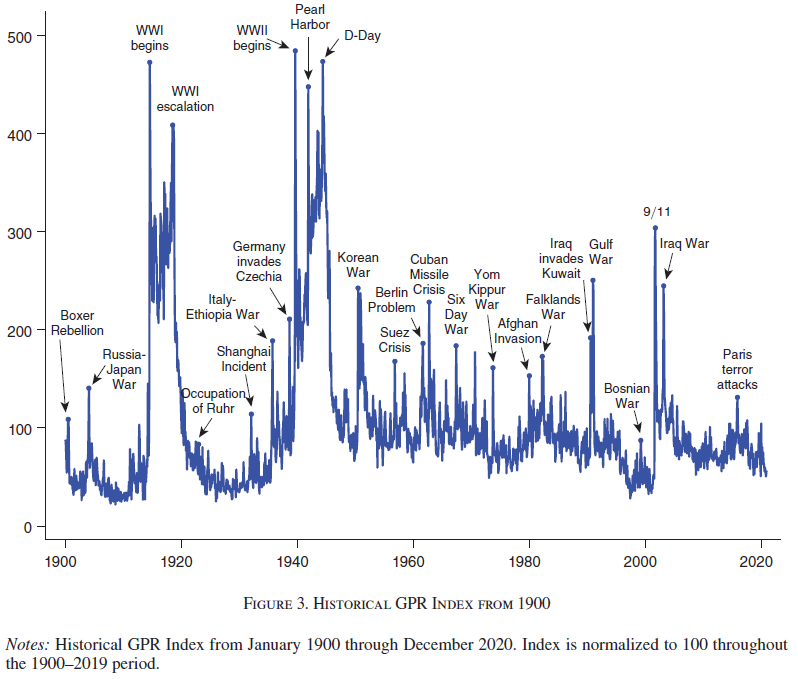
Caldara and Iacoviello (2022)
- News-based measure of geopolitical risk
5. INDIVIDUAL MORTALITY RISK
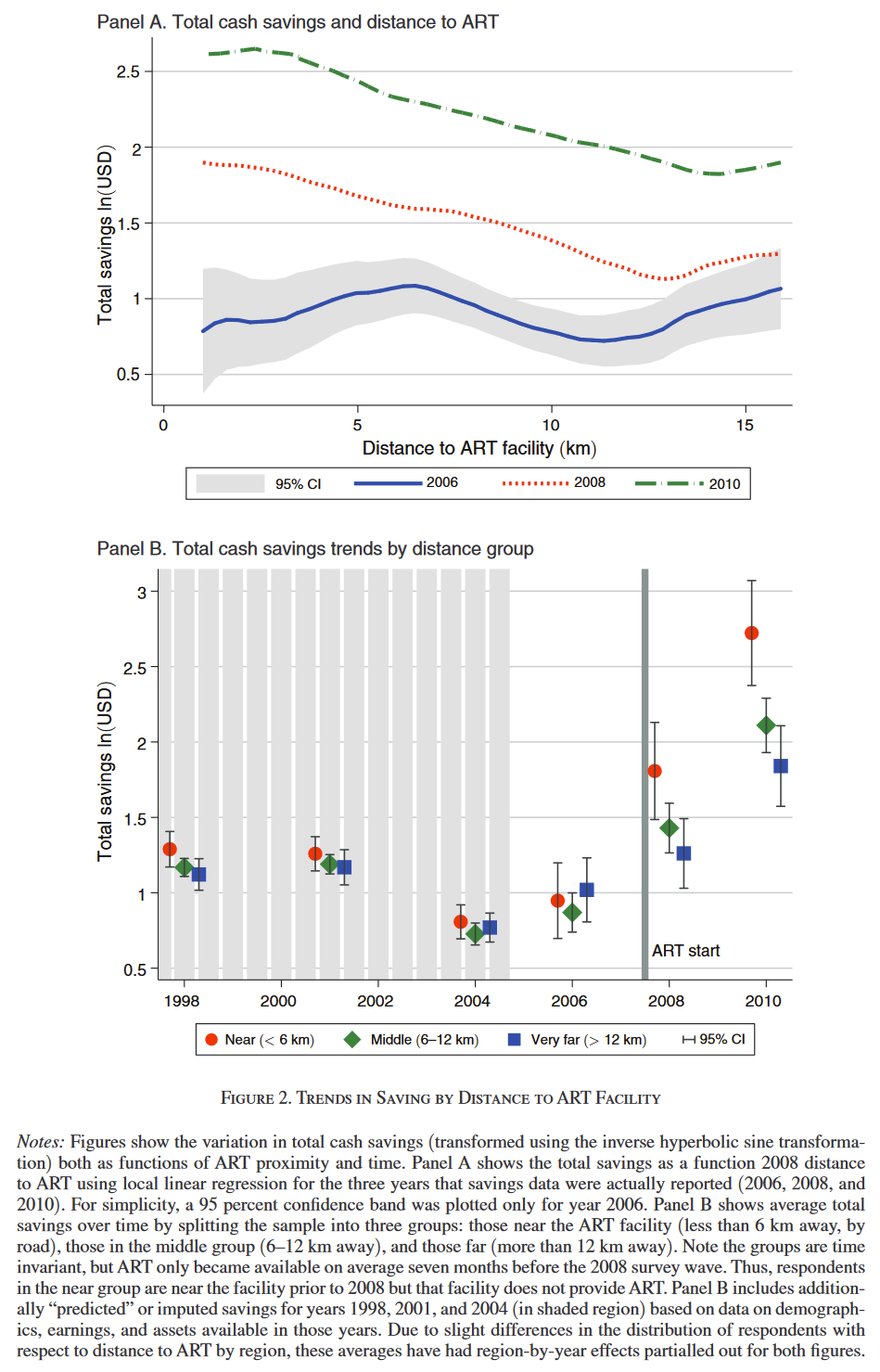
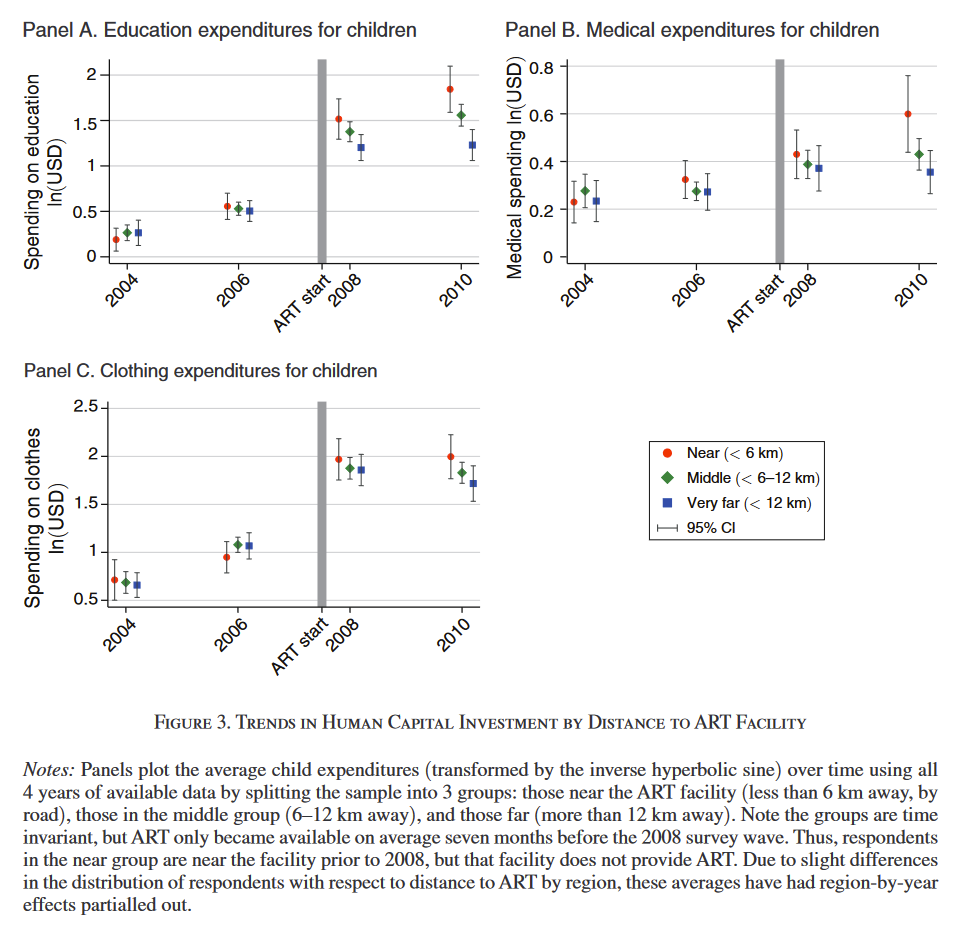
Baranov and Kohler (2018)
Title: The Impact of AIDS Treatment on Savings and Human Capital Investment in Malawi
Goal: estimates how life expectancy affects long term investment decisions
Context: antiretroviral therapy for AIDS in sub-Saharan Africa
Model: spatial and temporal variation in availability of ART
Punchline: ART availability increases savings and education due to changes in expected mortality risk
Hansen (2013)
Title: Life expectancy and human capital
Goal: estimates how life expectancy affects schooling outcomes
Context: international epidemiological transition in 1950s across a range of countries
Model: identified by large exogenous shock to life expectancy, especially from fall in pneumonia
Punchline: every extra year of life expectancy increases years of schooling by 0.17 year.
Hansen and Strulik (2017)
Title: Life expectancy and education
Goal: estimates how life expectancy affects schooling outcomes, and especially when life expectancy affects adults
Context: US cardiovascular revolution in 1970s
Model: identified from the large exogenous shock to life expectancy using diff-in-diff across states
Punchline: states with higher mortality rates from cardiovascular disease prior to the 1970s experienced greater increases in adult life expectancy when cardiovascular revolution arrived, and higher education enrolment, 0.19 to 0.41 more years of schooling per additional year of life
Jayachandran and Lleras-Muney (2009)
Title: Life Expectancy and Human Capital Investments
Goal: estimates how life expectancy affects schooling outcomes
Context: sudden drop in maternal mortality in Sri Lanka between 1946 and 1953, raised female life expectancy
Model: maternal mortality happens after education investment decisions but still early in adult life, and provide natural control group of men
Punchline: for every extra year of life expectancy, years of education increase by 0.11 years (3%)
Ciancio, Delavande, Kohler, and Kohler (2020)
Title: Mortality Risk Information, Survival Expectations and Sexual Behaviors
Goal: estimates how life expectancy affects long term investment decisions
Context: adults of age 45+ in Malawi had their pessimistic views about life expectancy updated
Model: randomised controlled trial for knowledge provision about mortality risks
Punchline: people with higher life expectancy do less sexually risky stuff and investment more in agriculture and livestock
6. OTHER ADJACENT LITERATURES
Climate risk
-
Etc etc
Pandemic bonds
Wolfers and Zitzwetiz on prediction markets and the Iraq war